
iPhone 4 / Hipstamatic / Wonder lens / Sugar film / incandescent light / iPhoto For iOS / Pro HDR / PhotoToaster
iPhone 4 / Hipstamatic / Wonder lens / Sugar film / incandescent light / iPhoto For iOS / Pro HDR / PhotoToaster

iPhone 4 / Camera+ / Flare

iPhone 4 / Pro HDR / iPhoto For iOS / PhotoToaster / Flare

iPhone 4 / Camera+ / Flare

iPhone 4 / Camera+ / iPhoto For iOS / Flare

iPhone 4 / B Shutter / handheld multiple exposures / iPhoto For iOS / PhotoToaster
iPhone 4 / Land / iPhoto For iOS / Pro HDR / PhotoToaster

iPhone 4 / Pro HDR / iPhoto For iOS / Flare

iPhone 4/ Camera+ / iPhoto For iOS / Pro HDR / Flare
In which an important tenet of information theory is illustrated, the strange wisdom of Quentin Tarantino is honored and The Author thankfully avoids killing a general contractor
Years ago, long before Richard Saul Wurman redefined himself with TED, he was my favorite information theorist–or as he preferred to call himself, information architect. And one of the many Wurman-esque things that has stuck with me is his observation that “people only understand things in terms of what they already understand.” This has served me well in terms of all kinds of writing and, in truth, has probably helped me produce more successful work than I otherwise might have. So yes: Namaste, Richard Saul . . .
But now let’s jump-cut to a remodeling project gone wrong. Over the past couple of months, I’ve had my screened porch remodeled. It was one of the archetypical domino projects: What started out as a-small-repair-due-to-a-leaky-pipe expanded to why-not-replace-the-wall, which morphed into a-new-floor-would-be-nice that, in turn, became now-the-screens-will-look-tired-better-do-them-too. So yeah–big-time Project Creep at its dubious best. Bottom line, everything wound up being redone, thus making it the world’s most expensive repair of water damage.
Don’t worry–I’m not here to obsessively share every step of the job. Because that would be the moral equivalent of 15 old-school slide carousels containing holiday snaps of a place you have no interest in featuring people you don’t care about. Suffice it to say that everything went splendidly (if way too slowly) except for one thing: the bead board ceiling.
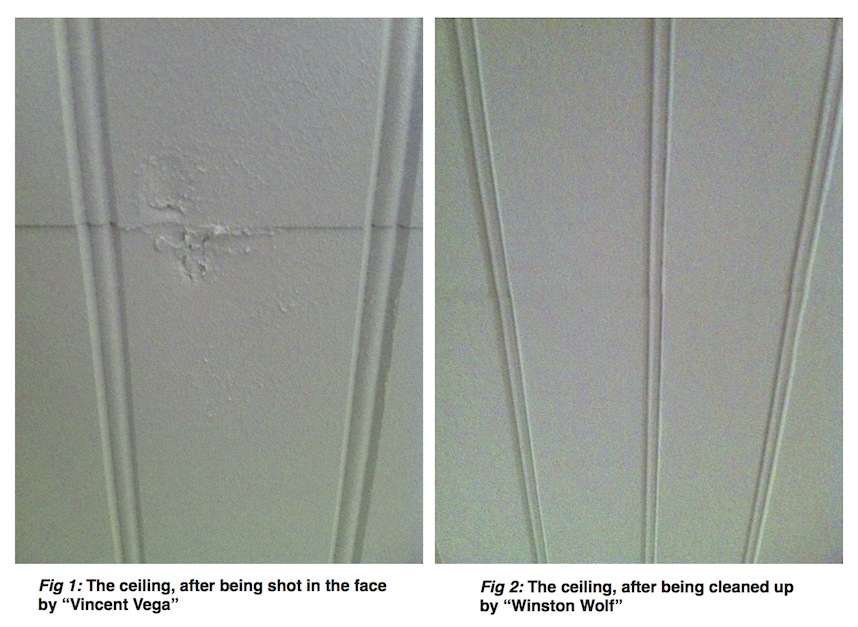
And I’ll even shorthand the bead board problem: 221 countersunk screws so badly filled that 95 percent of them were still clearly visible in the finished job. Here’s an even shorter description–Fucking Aesthetic Disaster (FAD). Given this, it’s also vital to know something pertinent about me: When it comes to badly executed projects by purported professionals of any sort, I make Steve Jobs look a go-along nice guy . . .
Jump-cut again to the general contractor and me standing on the “completed” porch. He had stopped by under the impression that I’d be settling up with him on the remaining 50 percent of the bill. He was, of course, delusional in ways I’d not seen since the heyday of blotter acid in San Francisco. So we were both standing there, mugs of coffee in our hands, surveying the project: floor, check; new wall, check; rebuilt bulkhead, check; new screening, check; new molding, check . . . But then sadly we ran out of the non-controversial, well-done portions of the porch. There was nowhere left to go except to slowly raise our collective gaze to the FAD that was my bead board ceiling.
There were many things the general contractor could have said at that point, each offering varying degrees of claimed ownership of the problem–even if only implicitly. However, he chose to probe the limits of my annoyance in an attempt to take the smallest possible responsibility. Thus taking a sip of coffee, he asked with an awkward cheerfulness, “Well, whatdya think?”
I, in turn, took a sip from my mug as I simultaneously searched for a diplomatic response and my Happy Place. And as usual, I failed miserably at finding either. “Well, here’s what I think–it’s the fucking ugliest thing I’ve ever seen. It looks like it was installed by blind, rabid, meth-addled chimpanzees with spit, a blunt army knife and a crowbar in-between wanking jags. That’s what I fucking think.” I gave him a dangerous, tight-lipped smile and then pulled on my coffee again. Contemplate those limits, mofo. After which I said nothing, having long ago worked out that it’s always instructive to let the other person fill the engineered silence.
The general contractor simply stared. My liver/fava beans/chianti moment had instantly forced him to cast aside Plans A through F of charming his way out of this. A hat-in-hand offer of a five percent discount coupled with back-slap was now so not the way to go.
“Errr . . . uh, well . . . um, yeah, I take your point. And I want to make this right–I’m going send Fred back to make this right.” Fred was the original installer of the FAD.
“Why the hell would you do that?” Okay, I hadn’t seen that coming.
“Well he’s responsible for this and I’ll make him fix it for you.” I noted that the general contractor had suddenly made himself blameless because now it was All Fred’s Fault.
“No, you won’t be sending Fred back precisely because the Fucking Aesthetic Disaster you’re looking at is either Fred working at the bleeding edge of his incompetence or–worse–in a deeply comfortable groove of I-don’t give-a-shit. Sending me either the same moron or the same guy who can’t be bothered is not the way you’ll make this right. Are we clear?”
This was not going well for the general contractor because a maniac was suddenly standing between him and a four-figure settling-up. “Well, what do you want me to do, then?”
Remembering Richard Saul Wurman’s tenet, I tried a new approach: “What I want from you is Winston Wolf . . . I want you to send me The Wolf.”
“Who the hell is Winston Wolf?”
“Ever see Pulp Fiction?”
The general contractor was perplexed at that this seeming change of topic. “Well, yeah–sure . . .”
“Remember when Vincent–John Travolata–shoots the guy in the car? Who do they call?”
He pondered this for a moment. “Um, Harvey Keitel–they . . . they call Harvey Keitel.”
“And Keitel plays Winston . . .”
“. . . Wolf!” the general contractor said, momentarily pleased with himself.
“And what does Winston Wolf do for a living?”
“He’s the clean-up guy . . . for when things get out of hand.” The general contractor was now deeply into this; it was if a pub quiz had suddenly broken out in front of him.
“Exactly. And that’s what I want–Winston Wolf. Because from where I stand, Fred is John Travolta, and he’s just shot my bead board ceiling in the fucking face–the construction version of blood and guts is everywhere. So what I need is a professional clean-up guy.”
The general contractor began to look cagey as he tried his best to play dumb. “How do you know I have somebody like that?”
“I know it because you subcontract all the time, and people tend to be morons and so it follows that a percentage of the guys who do work for you absolutely shoot their jobs in the faces. So yeah, you have a really good clean-up guy somewhere, and I want him here. Send me The Wolf.”
Like a beaten man laying all his cards on the table, the general contractor said, without even pretending to think, “Yeah, okay–I’ll send Phil out next week. He can’t come sooner, because . . . well . . . he’s busy.”
“Cleaning up after someone else, I’m guessing.” At this, the general contractor averted his eyes . . .
Jump-cut one more time to today, as I write this waiting for Phil The Wolf to show up and make right my bead board ceiling. I imagine that just like Harvey Keitel, he’ll come with trash bags and clear me from the area with a curt professionalism. After all, there’s metaphoric blood and brains to attend to and damage to seamlessly repair–and all this will require Phil’s undivided, specialist focus.
If there’s any kind of silver lining to this sad tale of power exchange and Wurman-eque explanation via classic film, it’s this: The chance, however slight, that Phil will arrive in a 1992 Acura NSX, wearing Harvey Keitel’s tuxedo.
I’ll let you know.

iPhone 4 / Pro HDR / handheld / Flare

iPhone 4 / Pro HDR / handheld / iPhoto For iOS / PhotoToaster / Flare

iPhone 4 / Camera+ / iPhoto For iOS / PhotoToaster / Flare
iPhone 4 / Camera+ / iPhoto For iOS / PhotoToaster / Flare
Notes on the sad state of audio remastering and how
cutting-edge technology is wasted by a greedy music industry
pursuing an increasingly less-sophisticated audience
And the end of all our exploring
will be to arrive where we started
and know the place for the first time
–TS Eliot
Recently I added another three terabytes of media storage space and decided to re-rip some of my CDs to the Apple Lossless format. After all, I now had room for songs that each weigh-in, on average, at 32 MB. Apple Lossless is essentially a bit-for-bit duplication of digital music that’s compressed and converted back on-the-fly to its perfectly replicated state. Thus the whole “losseless” thing–the digitalized music literally is the copied CD.
This has forced me to determine the most pristine source for each re-ripped CD. Which really is a genuine challenge because I collect music–lots of music; more music than you can imagine, and more than I will ever publicly admit to. Normal people have some Bowie CDs–probably not all of them. I, on the other hand, have a three different remasterings of Bowie’s complete works. This is not bragging–it’s an admission of an obvious problem for which I should probably seek professional help. I mention it because it follows that if I have three complete sets of Bowie remasters, well, there must be multiple remasterings of, say, the complete Miles Davis–and, god help us, you’d be right. Thus finding the best source for my new Apple Lossless duplications is a very real problem for me.
And yes, I know what you’re thinking: Well, no biggie, fool–just use the most recent remasters. Advancing technology means increasingly better re-digitaliztions. To which I say in the most world-weary music collector’s tone possible, You’d think, wouldn’t you? But frequently–perhaps even more times than not–you’d be wrong about this.
Let’s digress for a few moments–because an analogy is badly needed. Think of remastering in terms of the restoration of a piece of art. Remember a few years ago, when they restored the Sistine Chapel ceiling? Pretend that Michelangelo’s ceiling is Bryan Ferry’s Mamouna (simply because it’s been the cause of my most recent struggle). Okay, so you’re the art historian-cum-restorer and you’re standing there in the Sistine Chapel, staring up at the ceiling. What’s the first thing you’re thinking–what’s the project’s prime directive so to speak? If you’re sane, it’s Christ on a cracker, this is a fucking Michelangelo, revered the world over–first and foremost I must Do No Effing Harm. To which I once again say in the most world-weary music collector’s tone possible, You’d think, wouldn’t you?
And “harm” for our art restorer, beyond the don’t-physically-damage-the-damn-thing-it’s-priceless, would be a failure to return the Sistine Chapel ceiling to its original state–to fail to honor as closely as possible the Big M’s intention. Easy-peasy, yes? You’d think, wouldn’t you? So it follows that you’d do research–you’d find the earliest possible photos, you’d find the most protected pieces of pigment to ascertain the true colors of the work, you’d consider its entire palette and how the values work in relation to one another. That sort of thing. More full-bore easy-peasy, albeit labor intensive. You’d think.
Now imagine if, when reopened, the Sistine Chapel’s ceiling colors were Op-Art bright–yellows were school-bus hued; blues were all deeply IKB; flesh tones were more akin to those in HD porn. Imagine, too, that the ceiling’s dimensions had been made smaller, and that the background had nearly been eliminated in favor of the foreground. And finally, that God’s hand gesturing to Adam has been repositioned, even though only slightly. So what do we now think of the art restorer? Yeah–me too. I’ll just pop out to get torches and pitchforks for everybody . . .
Let’s review: restorations–physically, visually or sonically–should allow the audience in question to experience as closely as possible the artist’s original intent. We have a goal, we have a path and we have a yardstick by which to measure success. So what the fuck is going on with most audio remastering? This should be easy-peasy, right? You’d think, wouldn’t you?
My recent adventures in ripping cherished CDs to Apple Lossless have underscored something horrifying–for all of the reasons outlined above, close to 80 percent of my remasters are simply not as good as the original releases they replaced and put out-of-print. Far, far from it. In these cases, a Sistine Chapel ceiling went into the remastering studio and a version painted on black velvet came out. Easy-peasy my ass.
On the way to ripping Bryan Ferry’s 1994 Mamouna, I did A/B comparisons of four CD versions to the original UK vinyl pressing of the recording. And because I sense that the suspense is killing you, I’ll cut to the chase: the US Virgin 1994 CD of Mamouna–its first appearance on compact disc–blows away the touted-at-the-time 1999 remastering in all possible ways. The 1999 remaster narrowed the sound stage, eliminated space between instruments and lost an integrated sound in favor of individual instruments which were all made to take what can only be described as the in-place equivalent of solos. We’re talking an aural aggressiveness that borders on harshness. And so 19 years on, down a road that passes by massive technological advances in sound processing and digitalization, I’ve chosen the first CD appearance of Mamouna to preserve with a lossless technology that didn’t exist when it was released. This is so not easy-peasy; this is unacceptable. We have the capability of exactly capturing Bryan Ferry’s intention two decades ago, and we choose not to do so–to instead rethink the release in a way that, one can only assume, makes financial sense 19 years on.
By “financial sense,” I’m not referring to the cost of the remastering itself. Because in this case the tapes were in good shape and, given the history of sound recording, 1994 wasn’t that long ago. You want cheap? Here’s contextual cheap: Find the master tape that’s upstream of the version EQ’d for vinyl. Play it back on the same deck that recorded it (or one like it) connected by a single cable unmediated by any sound processing devices to the best digital recorder you have. Sample the master at 192kHz/24-bit. Done: a near-perfect sonic snapshot of what Ferry left on the original mastering recorder when he exited the studio well-pleased two decades ago. How hard can this be? All things considered, it’s easy-peasy. At least you’d think, wouldn’t you?
So no, the “financial sense” I’m referring to is the only metric the music industry pays attention to–the number of units moved, or–in this case–the number of units resold to those who already have a copy of Mamouna and, hopefully, to new, younger potential fans. For those already owning Mamouna, the remaster has to sound “new;” for younger, potential fans, Mamouna has to sound of-the-moment rather than 19 years old. And the single answer to both these needs is to change the recording by way of deforming it in the remastering. This is definitely not about Artistic Intent. Rather, it’s about differentiating as if it were Coke New Mamouna from Old Mamouna for one market and making it of a piece with the compressed, shrill and MP3-based music that’s the sonic reality of younger audiences. The music labels change releases when remastering them because it makes marketing (and therefore financial) sense for them to do so.
Purists will insist that however onerous, this technically remains a remaster rather than a remix–but I don’t. Because when a previously subtle bass leaps to the front and comes thundering out of the speakers, when the sound stage narrows, sifting instruments to the center in a kind of stereo-mono and when integrated instrumental interplay is shattered by hyper-detail in the manner of an overcooked HDR photo, it is a remix in all ways but the name. Who you gonna trust, the purists say–us or your lying ears? Me, I’m going with the thing that walks and talks like a duck.
I’m genuinely outraged by all of this. We’ve reached a point where we can almost be plunked down in the studio next to Bowie as he records Station To Station or with McCartney as he listens to the final mix of Ram or by Harrison’s side at the playback of All Things Must Past. Instead, we got terrible remasters of all these recordings–garish parodies of themselves–like film stars with too much Botox . . . It nearly makes my music-loving head explode.
But having said this and understanding that my ranting is ultimately useless, I still cling to the dream that someday the best music in my collection will be direct, flat transfers from the original master tapes. And if I can further hear the splices between songs, I’ll be even happier. Given today’s technology, this should be easy-peasy. You’d think, wouldn’t you?

iPhone 4 / Camera+ / iPhoto For iOS / PhotoToaster

iPhone 4 / Camera+ / iPhoto For iOS / PhotoToaster / Flare

iPhone 4 / Camera+ / iPhoto For iOS / PhotoToaster / Flare

iPhone 4 / Pro HDR / iPhoto For iOS / PhotoToaster / Flare

iPhone 4 / Camera+ / iPhoto For iOS / PhotoToaster / Flare
 CultureHack