Elevator Pitch: Christine O’Donnell Ad Proposal

Hellooo, voters. Look at your candidate. Now back to me. Now back to your candidate. Now back to me.

Sadly, he isn’t me. And if he stopped being an elitist, socialist liberal with Yale values, he still wouldn’t be anything like me because I’m you. Look down. Back up.

Where are you? You’re on the campus of Oxford University. With the candidate your candidate could only hope to be. What’s in your hand? Back at me.

I have it. It’s tourist bureau photos of Claremont Graduate University and Princeton. Look again. The campus photos are now diplomas. Anything is possible when your candidate is like you, or at least slower and more desperate. I’m on a broomstick.

(Look down. Back at me. I’m Christine O’Donnell and I authorized this ad.)

The Writing’s Sonic Debris Field

In O! Lucky Man, Lindsay Anderson’s savage film about post-war Britain, someone observes that you won’t make it in the catering business unless you know what to do with the leftovers–and so complete is my agreement with this food-station insight that I’m about to apply it to “Overture,” the audio file embedded in this post. But before we can get to it, to its what, we need to detour through the vaguely akimbo why . . .

At its most distilled, my ongoing work-in-progess is a novel about a former pop musician eventfully remixing a collection of songs from years ago–songs which were the last he wrote. (And if, by chance, I’ve just saved you $26.95, you’re very welcome.) High-concept-wise, it seemingly doesn’t get any simpler than this–but the operational word here is seemingly, and it’s underscored half a dozen times.

The work-in-progress didn’t start out simple: For the first time as a professional writer, I was visited by something that behaved very much like that phrase I’m too superstitious to bang down here. The awful thing that rhymes with Fighter’s Lock. Yes, uh-huh, you know–that which shall resolutely remain nameless. I’d labored for months working out the structure of the book; spent days researching Bosendorfer grand pianos; had meticulously outlined how each sequence of the story unfolded. And yet there I sat–unable to get beyond page 12. This went on for what seemed forever, even allowing for the time spent in Full-Out, Fuck-Me-Hard-It’s-All-Over Freak-Outs.

And then one day–when I was uncomfortably close to bashing-out a series romance novels under the name Christana Metroform to support my obviously washed-up self–I worked out what was wrong. I couldn’t move my protagonist into the remixing process because I onlyconceptually understood what he was tweaking. How to explain this? In terms of the songs he was rethinking, I was attempting to conjure up the tips of the icebergs and not the icebergs themselves. In the case of Page 12, I thought I only needed two actual couplets from an imaginary song which would be expected to feature a 60-line lyric. And, of course, I was Deeply Wrong.

Cue my personal Kubler-Ross Moment: Fast-forward through the numerous meetings of forehead and palm, through the finger-drumming, through the angry denial, to–yes–an acceptance of what needed to be done. Before I could write the book, I needed to write the songs. Like it or not, in order to reveal the tip, I needed to construct the whole goddamn iceberg. Fourteen of them, actually.

And this is how I came to ring up my songwriting partner from so long ago that years and years can be considered equal parts avoidance and spin. “We need to come out of retirement,” I said. “I need songs that no one but you and I will ever see.” Could there have been a sexier, more seductive offer? Apparently not, because we spent the next few months writing and recording my protagonist’s last collection. One that he would pick apart in the studio. (Full-disclosure: After asking my former collaborator to write material that only peeks through the novel’s prose, I neglected to tell him that the songs would also be turned inside-out over the course of the book. I don’t feel guilty about this–sometimes an offer can be too sexy and seductive.)

More fast-forwarding: The demos that represent the pretend collection of my fictional songwriter were completed and, lo, they turned out to be much more than research–at least to our ears. Yes, they were written in-character; yes, they were, by design, in the manner of old-school singer-songerwriter material, but they somehow transcended their deep-background status. Fast-foward once again: The demos did the trick, and my work-in-progress instantly moved beyond page 12. If not exaltation in the streets, there was at least a bonafide Risky Businessmoment that involved me, tube socks, underwear, savage air guitar and a waxed, hardwood floor. But, critically (and less disturbingly), something else happened.

I still remember pointing out to my collaborator that beyond functioning as a soundtrack to the book, the songs were narrative enough to be a set of theater songs. Which–finally–brings us to “Overture.” As I continued to wrestle with the book, my collaborator wrapped a selection of demo melodies into–well, you know.

Yet more fast-fowarding: Discussions with a theater company ultimately fell apart and, sucked back into my writing, the spin-off demo faded into the background. Until today, that is, when I rediscovered it while searching for another demo I needed to tweak the manuscript. Unsurprisingly, “Overture” has remained baroque, fun and, er, theatrical–so what to do? what to do? Spoiler alert: it’s attached to this post . . .

At this juncture, it’s not my intent to release the demos into the wild. After all, they were created for my ears only and it would would be very much like including my working outline with the book. (Which, it occurs to me, is not completely true–there are three songs that definitely transcend their origins, even the being-written-in-character-and-genre bit.) But “Overture” is something different; something designed to be a once-removed core sample of the original demos. And because of this, “Overture” isn’t the inspiration for anything in the novel and, more importantly I’ve a distinct intellectual distance from it. So why not? Why the hell not, indeed.

Thus, Gentle Reader, here’s a glimpse into the musical underpinnings of my work-in-progress that, in their sheer and dramatic orchestral-ness really aren’t underpinnings at all. Insert here your favorite one-hand-clapping metaphor for paradox. If this were a film trailer, “Overture” would be the over-the-top scene that doesn’t feature in the release print–that extra exploding car hurtling pieces of itself at the camera before the smash-cut to black and “Coming Soon.” Up until now, I’ve always wondered about those kinds of trailer moments–why aren’t they included in the release? But having rediscovered “Overture,” I now understand: They’re unrepentant shards of because-we-canfilmmaking that don’t fit into their respective movies and yet remain too cool for the cutting room floor. It’s less a con game than self-indulgence. And you know, I’m okay with that . . .

“Overture.” Smash-cut to black. Legend: “Coming Soon.”
[restore audio link]

Hirsute Hope Springs Eternal

Welcome to what’s probably my 80th beard. And, of course, these days I’m thinking: “80–that’s a very lucky sound number if ever I heard one.” Because, like someone with a gambling problem, my urgent need to believe makes everything seem like, well, An Auspicious Sign.

What I so passionately embrace is that this time, this beard will make me look like exactly Sean Connery. I’ve even wandered around for days speaking in a thick Scottish burr to encourage the growing whiskers. 

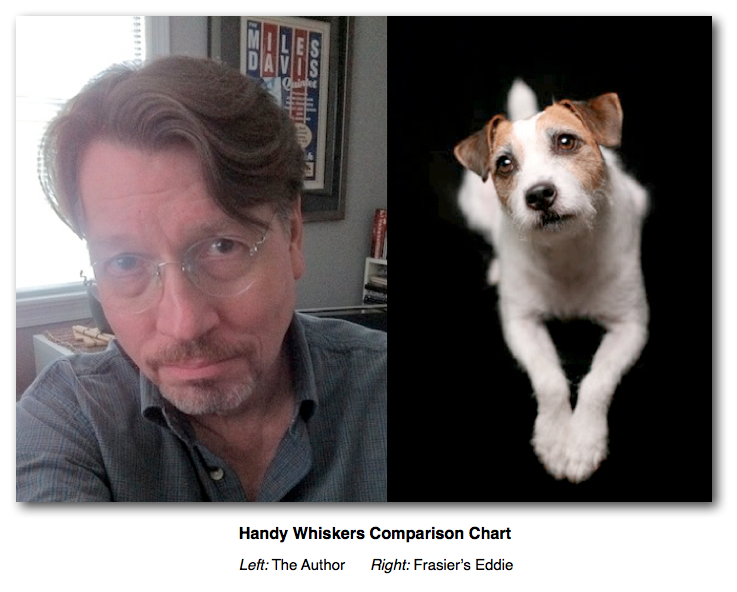
So much, then, for belief–because what I actually know to be true is that any day now I’ll catch my reflection in a window and see that once again I bear a striking resemblance not to Sean C, but Eddie, the Jack Russell on Frasier. (See chart below.) So much so that I’ve seriously considered boot-blacking my nose and going trick-or-treating this year.

But let’s pause for a moment and think about this: My eightieth beard. Really? You might think this implies that those other 79 runs at Sean-dom which ended in Deeply Jack-Russell-eques ways have taught me nothing. And you’d be right.

Here’s the thing: Where anyone else would recognize obsessive-compulsive behavior and seek help (me–I’m Kulturhack, and I can’t stop growing a beard; them–Hi, Kulturhack, welcome!), I see a touching, very American belief in perfectibility–even in the face of enormous odds. Deep in my heart, I just know I can bootstrap my way to Sean Connery, if only I keep at it and blindly ignore the facts.

And further, I think I should be forgiven this naivety. After all, I’ve watched the Palins, Angles, Bachmanns, and even O’Donnells attempt to will themselves into high office in spite of the overwhelming facts. I dream of being Sean Connery; they undoubtedly want to be president–and the fact that at the end of the day we’re all Eddie has never slowed them–or me–down . . .

Put another way: The day Sarah Palin takes the oath of office as president of the United States, I’ll be Sean Connery.

I just know it.

Theauthorandeddiecaptioned

“Jimmy,” Visualized

Okay, I’ll admit that I’m intrigued–the posted reading of “Jimmy,” intended for my reference use and not public performance, has been doing doing, er, rather well in terms of visitors. A smarter individual would pretend that this development had been foreseen, but trust me, it wasn’t.

Thus, this is the logical conclusion to the posting of an excerpt from my work in progress that included the “Jimmy” sequence and the followup entry including my reading of it. With a tad of hubris (but a lot more raw curiosity), here’s the visualization of that reading:

To those of you who remain disinterested (and those of you who’ve become increasingly annoyed by all this repurposing), take heart–the chances of a film version remain astronomically slim and years
away . . .

“Jimmy” (And Audio Companion To “Limitations”)

There’s been surprising amount of positive feedback on “Limitations,” the most recent excerpt from the on-going work-in-progress–and, intriguingly, a number of readers have asked about the rhythm of the prose in this sequence: was my intent to be formal or conversational? To which, of course, the answer is yes.

As I’ve earlier indicated, this project is unique in terms of my writing in that the final draft is always the one that best reads aloud. So determined am I, that I’ve actually passed over better “page writing” in favor of the version that’s better spoken. (Confession–at first, doing this gave me a deeply sick feeling, but I’ve gotten used to it.)

Thus, I’m in a unique position to address (if not answer) that prose-rhythm question because I have the recordings of the work that were made to help me decide what became final drafts. Here, then, is the “Jimmy” sequence from the previously posted “Limitations” excerpt. And to make things a bit more interesting, I’ve retrofitted a soundtrack on the recording. (Well, after all, I had to do something–I’m a writer, not a professional narrator . . . )

Thanks again for all of that kind feedback.

[restore audio link]

“Jimmy”

Written and read by yours truly (from a work-in-progress)
Music: Max Richter, “I Was Just Thinking,” from 
24 Postcards In Full Colour

(remixed by me)

Limitations

Excerpt From A Work-In-Progress

Without limitations, everything’s possible–and that’s the problem: everything’s possible.

Studio World makes it easy to get lost chasing digital perfectibility. Here, creation is decoupled from time and space and–frequently–any sense of perspective. (Which, you suppose, says something about the world, since God had worked under similar conditions.) Most stillborn projects aren’t the result of drugs or writer’s block. Rather, it’s the seduction of 52 tracks and the lure of endless tweaking: a song that can be perpetually fixed-in-the mix instantly becomes addictive, and then every few hours that little musical problem turns out to be Not Quite Dead. Even in the studio most of us do things that just aren’t good for us. 

Bryan, after Jimmy, there at the dawn of music’s digital age: trapped for seven self-indulgent years inside 50 desk-direct recordings. Obsessively laying tracks and then endlessly deciding among the infinite “final” mixes. And so, in the end, the big surprise wasn’t that the album never came out–it was that something quick-and-dirty did: a collection of covers recorded in three weeks; a release in all senses of the word.

Jimmy, before Bryan, in someplace inaccessible during the old analog days, with his master tapes actually wearing out; their ferric oxide scrapped off edges-first by endless runs across play heads. Jimmy had been looking for Perfect Mixes, and, in retrospect, he’d been having a breakdown. But the legendary, self-destructing masters was only the most repeated story; the one sane enough in later years to share with dinner guests. The last song completed had been something musique concrete, but approached almost as if it were dub: the vocal was Jimmy, heavily reverbed, speaking a session guitarist through a blistering solo note by fucking note–however, all of the guitar had then been replaced by a digital cello carefully programmed to ignore everything Jimmy had commanded. Thus “No, goddamnit, it’s E beforeG; right there at the 5th fret” tore through the dark chocolate melancholy often and to no avail. Like a tape loop–until it finally sunk in that someone had done this in real time. After which it became disturbing in a way that even edgy performance art isn’t, andeliminated any need to wonder whether Jimmy ever recorded
again . . .

My Cartier-Bresson Full-Frame Period

After being floored by the Yves Klein exhibition at the Hirshhorn, I decided to cut through Smithsonian gardens to really see what the iPhone 4 camera was capable of–which had the added benefit of an expanded palette to balance-out all that International Klein Blue . . .


Here’s a selection of the results, untweaked and defiantly uncropped:

Img_1473Img_1499Img_1505Img_1535

Mr Gibson Delivers

Zero History, William Gibson’s new novel, has been released today. I’m a littler over a hundred pages into it, and WG is making the prose sing in a way equal to Pattern Recognition, my favorite of his novels to date.

Really? you say cautiously, looking askance at me, ready to be dismissive of any fanboy worship you detect. Except there isn’t any because none is needed. In terms of prose style, Gibson has mashed Banville into Ballard to often wondrous effect:

In the amusement arcades, he judged, some of the machines were older than he was. And some of his own angels, not the better ones, spoke of an ancient and deeply impacted drug culture, ground down into the carnival grime of the place, interstitial and immortal; sundamaged skin, tattoos unreadable, eyes that peered from faces suggestive of gas-station taxidermy.

He was meeting someone here.

‘Nuff said . . .

Of Earthquakes And Bad Dreams

For me, verse is infrequent punctuation to the constant flow of prose. Infrequent and also unexpected, because while I arduously search for the next elusive sentence no matter how long it may take, the poems thus far have always found me and arrive nearly whole when they do.

And though I dutifully capture and refine them, I’ve never been sure of their exact relationship to any of my long-form writing. But thinking about it, that’s not quite true. It’s less about uncertainty over the poems and more about the fact I try not to dwell on them. Maybe because I see them as momentary and  inexplicable impulses–like a split-second homoerotic thought or an instant of darkness while standing slightly too close to  the edge of something dangerously tall. It’s better not to think about these things too much; best not to follow their respective logics to whatever destinations they may lead.

And so all I can do while remaining honest is to shrug and and introduce the latest from what  is clearly my bicameral self–mostly produced by one part of me to the slight astonishment (and occasional annoyance) of the prose-centric other chamber: An aftershock from the East Coast quake woke me in the middle of the night last week–in much the same way that bad dreams regularly do. And instantly the entangled gist of “Aftershocks” was there, forcing me to polish it when I should have been bashing-out exposition. Natural disaster, meet neurosis; aftershock, this is anxiety.

But now it’s done, and true to my word, I’ll be more than happy to stop thinking about it. After all, no one needs dangerous thoughts at the edge of dangerous places . . .

Aftershocks

In the middle of the night,
after the event,
my world shakes yet again.

And I wake with a sharp
intake of breath
to the creaking and tremble
of the costly protection
I’ve constructed around myself.

The tremor passes
as it always does,
leaving me sleepless and agitated,
until at last I make my way
out of the darkened corridors:

To the place where this fear of sudden shifting
can be exorcised–
to where I can bathe in a pool of light
that eases this breathless sense of drag,
that staves-off this suddenly endless night
with the steady glow of a ceaseless present
that glides across the screen.

Fitz And The Tantrums, Curated

Sometimes you stumble across a band that’s like a holiday infatuation–it’s all about a specific time and place, and unlikely to have a future. But that doesn’t matter because you’ve already surrendered to visceral joys of the moment.

Meet then, Fitz and the Tantrums: I’m currently having a torrid, retro affair with them behind the backs of Miles Davis, Peter Hammill, Leonard Cohen and the Pet Shop Boys. I know . . . I know . . . No good can ever come of this–but it feels so damn right. And yes, ultimately they’ll wind up disappointing me or I’ll prove to be a Fickle Fan. Or perhaps both will happen, and we’ll break each other’s hearts. 

But now–right now–they’re massively sexy and get 10 cool-nerd bonus points for having a drummer who looks like Rainn Wilson.

So sue me (but don’t tell Miles) . . .


The Natural Impressionism Of Coastal Fog

I brought a good camera on holiday, but I’ve opted not to use it. 

There’s something about the inherent imperfection of the iPhone 3G camera that appeals to me–the process morphs from controlled to ever-so-slightly guided. And–not surprisingly–interesting, embraceable mistakes occur . . .

Img_0830


Img_0831


Img_0839b

The Real Third Rail Of American Politics

It never seems to fail–I go into snarky-commentary hiatus in Maine, and disturbing things transpire: this time around, one in five Americans believe that Obama is Muslim http://bit.ly/bcG5Qh , while 61 percent of Americans oppose a second mosque blocks away from Ground Zero http://bit.ly/boVevL http://bit.ly/9F3aNZ . And those pundits–both right and left–who aren’t attempting to spin these lies to their advantage have been trying to explain How/Why It All Happened http://bit.ly/d2NABT

But no one is grabbing the real third rail of American politics. The reason is, of course, that this truth is both inconvenient and electorally dangerous: pointing it out will take away one of the clubs being used to beat Republicans around the genitals and at the same time insult voters Democrats hope to attract in a few months. But inconvenience and danger don’t make this insight any less true . . .

Of course Republicans, NeoCons and Assorted Wingnuts are the sources of the misinformation about Obama’s religion and the fake outrage over the proposed mosque down the street from Ground Zero. (Did I mention it would be the second one within blocks of the World Trade Center site?) It’s absolutely them: they did it, case closed, book ’em Danno. 

But here’s the thing–I’m not particularly angry at them. This is simply what they do. Were I to stand in front of the tiger enclosure at the zoo and stick my hand between the bars, where, precisely, are my grounds for shock, surprise and anger as I’m being fitted for my new prosthesis? It was a tiger–and, given a chance, chewing off my hand is just what tigers do. This is how I feel about Republicans, NeoCons and Assorted Wingnuts–they are the quintessence of that old punch-line: “Lady, you knew I was a snake when you picked me up.” Put another way, you can’t blame a man for trying–even if that man is Hannibal Lecter . . .

Which brings us to the dangerous aspect–the third rail itself. All 10,000 crackling volts. The genuinely appalling aspect of this twin tempest of Obama’s “real” religion and the fake mosque outrage is not the lying, figurative priests or their respective devout, politically blinded congregations–it’s what it says about the American public-at-large. 

When one out of five citizens believes that Obama is a Muslim, what’s easier: (1) solemnly stating that survey respondents are saying it to obliquely register their displeasure with the Federal government and its policymaking or (2) taking a deep breath and suggesting that the American public-at-large is crazy-stupid/peasant-ignorant with almost non-existent intellectual curiosity and an inability/disinclination to use The Google for anything more than Lindsay Lohan news and porn?

This is not elitism–I’m not referring to the benefits of college or upper-graduate degrees. We’re talking native intelligence here, the kind that’s not about schooling and all about what was once known as common sense. Confession: when I’m standing in a grocery store line, I happily pick up a tabloid and read about how the Alien Bat Babies Found In A Satanic Nursery will quite possibly Fulfill The Prophesy In The Just-Discovered, Newly Expanded Book Of Revelation. As does the person in line behind me–who, quite often, is utterly unlike me in background and education. Sometimes this person is far more sophisticated than I’ll ever be, and at other times, he/she is rougher around the edges. But always–as in every fucking time–we both look up from our tabloids and smile knowingly at each other, shorthanding Who exactly believes this shit? The rocket scientist and I do this; the single mom from the trailer park and I do this. Calling out blatant bullshit cuts across education, status, class, religion and race. Calling out bullshit is the great leveler. Or rather, it used to be . . .

But now, seemingly not so much. With regard to politics, people are reading about Alien Bat Babies and rushing out of line to stock up on toilet paper, milk and eggs because, you know–oh-my-god, something nebulously awful that’s never sourced or questioned is happening! And when I see this occur, I sneer and mutter asshats under my breath. Because this isn’t about Republicans, NeoCons and Assorted Wingnuts–who, after all, are the equivalent of the writers and editors over at National Investigative News of The World: like the tabloid publishers, they’ve always been obvious sleaze-balls who can never be shamed. But the fools rushing up and down the paper products aisle? Well, they really, really should know better. Because they were once better and smarter and more discerning than this.

So until someone of significant pundit-y clout puts the responsibility for both the Obama-is-a-Muslim tempest and the faux outrage over the proposed mosque squarely on the shoulders of an uninformed mainstream America that’s behaving like addled meth-heads with ADD, I’m rapidly losing interest.  

Call me when the gong you want to beat is, say, the real one . . .

The Further Adventures Of My iPhone Camera

Today’s now-obligatory, interesting-to-only-a-handful shots of Maine:


Geometric teal and gray filtered through the whole wabi-sabi thing–need I say more?


Img_0621


“Sitting in an English garden / Waiting for the sun”


Img_0702b


Headlands (150 feet tall–did I say I hate heights more than Jimmy Stewart in Vertigo?)


Img_0641b


Wild ducks, sensing my love of pop music, form a series of Flying V Stratocasters . . .


Img_0725

Office Space: Elvish Holiday Iteration

At last–a genuine reason to wear shades while writing, and not feel like Hunter Thompson.


Well, yeah, okay. Maybe a little like HST; there’s a scotch just out of frame. (And thus for the duration of the week, I shall be referring to the work-in-progress as Bad Craziness In Maine: A Savage Journey In The Heart Of Downeast.)


At least it’s not Bat Country . . .


Img_0149