One haircut, indivisible,with tumble-down forelocks for all. (If I told you how to perform our secret handshake or where we meet, I’d have to kill you. I’m just sayin’ . . .)

One haircut, indivisible,with tumble-down forelocks for all. (If I told you how to perform our secret handshake or where we meet, I’d have to kill you. I’m just sayin’ . . .)
I . . . I think I’ve had a past life–because, well, I feel like I’ve been here before. This sounds crazy, but I know this place. Holding the snow shovel, I say, God-damn-son-of-a-bitching-bastard! and feel as if I’ve said these things before–and it seems like I said them only yesterday . . .

An excuse to capture video with an iPhone 3G.
See it as a Sundance entry from South White Hell . . .
Why, thank you, Lloyd–I think I will have another . . .

This is the man who snaps the cat that watches the squirrel that eats the bread . . .

The Big Dig, day two: Mission Find-The-Car. I feel like Indiana Jones after being dragged by that truck, and the Extra-Strength Tylenol is already out and waiting . . .
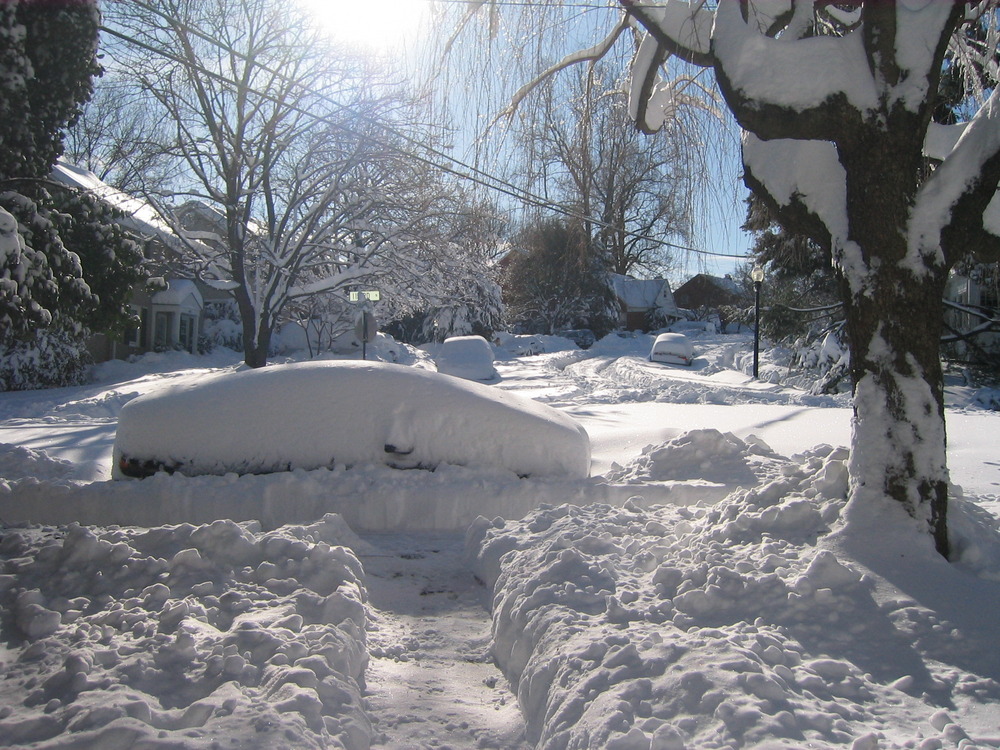
Let me put you behind the wheel of a brand-new Mazda Igloo! It’s stone-cold savings like you’ve never seen!
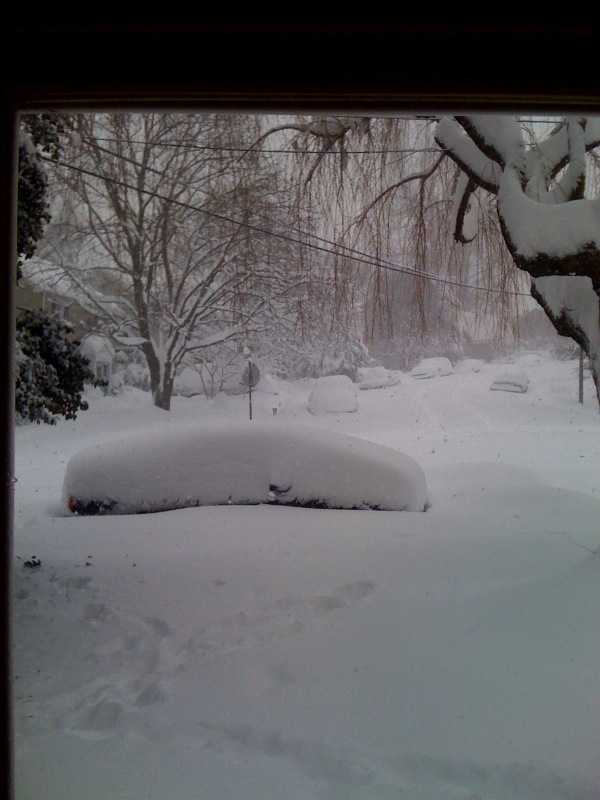
The big maze in which I eventually chase Doc is out-of-frame to the left.

Damn, damn, damn, damn . . .

Black coffee, white snow, aluminium-clad Mac–my monochromatic life. Note to me: Change into gray polo shirt and black jeans; it’s important to go with the flow . . .

Snowfall in a small Southern town with an inordinate number of marble buildings . . .

The 20 collections of music on this list have three things in common: (1) They were all released in 2009, (2) they were all purchased by me and (3) of all the music I bought last year, these are the ones that ended up within six feet of the player and remained there until New Year’s Eve.
See this as an honest look back–it’s not about new music or fashionable music or infrequently played music. This is the stuff that wound up providing my life’s soundtrack for those 12 months–not by design but, well, accretion: The pieces took hold at an almost unconscious level and never let go.
What’s evident from this idiosyncratic list–which, sadly, is only a part of my purchases in 2009–is that I am to the music industry what a high-roller is to Las Vegas, and yet the major labels, Big Radio and most venues are doing nothing to tap, much less encourage, my spendthrift behavior. I submit to you that this music industry blindness is far more problematic and damaging to profits than iTunes or piracy because I can say with a fair degree of confidence I’m among that 20 percent of consumers that, if courted, might provided the proverbial 80 percent of profits.
Which brings us to what’s not apparent about this list–with one exception, I bought physical copies of all these releases. (The Joe Pernice originally arrived as mp3s, but was soon replaced by an actual disc.) Make no mistake–they all wound up digitalized, but they began as collectable objects. Something the distribution chain should keep in mind as compact discs are squeezed out of existence by downloads at one end and retro-vinyl at the other.
Anyway, welcome to my most-listened-to musical world, circa 2009–this is why all of Amazon’s fuzzy-logic predictions about what I’ll want next are almost always memorably wrong . . .
Like some sort of unintentional core sample, this song gracefully arcs across Tom Waits’ Asylum, Island and Anti years, distilling what’s notable about each of these periods. Think of it as his Greatest Hits encapsulated in a single monologue . . .
We put up our tent on a dark
green knoll, outside of town by
the train tracks and a seagull dump
Topping the bill was Horse Face Ethel
and her ‘Marvellous Pigs In Satin’
We pounded our stakes in the ground
All powder brown
And the branches spread like scary
fingers reaching
We were in a pasture outside Kankakee
And One Eyed Myra, the queen of
the galley who trained the
ostrich and the camels
She looked at me squinty with her
one good eye in a Roy Orbison
T-shirt as she bottle fed
an orangutan named Tripod
And then there was
Yodeling Elaine the
queen of the air who wore a
dollar sign medallion and she
had a tiny bubble of spittle
around her nostril and a
little rusty tear, for she had
lassoed and lost another tipsy sailor
And over in
the burnt yellow tent
by the frozen tractor, the
music was like electric sugar
And Zuzu Bolin played
‘Stavin’ Chain’ and Mighty
Tiny on the saw and he
threw his head back with a
mouth full of gold teeth
And they played ‘Lopsided heart’
And ‘Moon over Dog Street’
And by the time they played ‘Moanin Low’
I was soakin’ wet and wild eyed
And Doctor Bliss slipped me a
preparation and I fell asleep with
‘Livery Stable Blues’ in my ear
And me and Molley Hoey drank
Pruno and Koolaid and she had a
tattoo gun made out of a cassette
motor and a guitar string and
she soaked a hanky in 3 Roses
and rubbed it on the spot
and drew a rickety heart and
a bent arrow and it hurt like hell
And Funeral Wells spun Poodle Murphy on the target
as he threw his hardware,
Only once in Sheboygan did he miss
at a matinee on Diamond Pier and
she’d never let him forget it
They were doing two shows and she
had a high fever and he took
off a piece of her ear and
Tip Little told her she should
leave the bum
but Poodle said, “He fetched me
last time I run.”
But I’d like to hammer this ring into a bullet
And I wish I had some whiskey and a gun
my dear
And I wish I had some whiskey and a gun
my dear
–Tom Waits
I’ve just upgraded my Dropbox account to 50 GB, and upon doing so, this is where I was taken. While there are many technical reasons to love Dropbox, this adds Memorable Off-Center Humor to the list . . .

Excerpt From A Work-In-Progress
After five summers’ growth, the birch is big enough to finally stand on its own. So on an autumn afternoon, you find the wire-cutters and release the tree from its bonds. But its chance has been missed–the damage is done–and it stays rooted there, too close to the house. The other saplings that replaced the elms are also beginning to grow, and the stripped-back starkness of the town is gradually being obscured. It’s then you realize that if you stay, the reality of this place will similarly fade–that even when it’s no longer seen, it will still be there just below every surface. You’re seventeen now, and the only thing that should matter is not taking root in your yard: staying here will drive the family’s local history yet another generation deep. But it will also place an emotional buffer between you and everything unforeseen. Because in the end, home really is the place where they have to take you in. Like your great-grandmother or Christopher’s cousin or Mrs Thompkins’ sister’s kids. What’s going to happen if you need somebody when you’re far away from here? When none of your emergency telephone numbers have local area codes? Because this is the place where all of your friends are–but it’s also where most of them will die. Thus moving on means doing so by yourself and then falling out of touch. It happens already in miniature, when classmates are transferred to other home rooms. And even now you understand that the fading-away is your leveraging of physical distance; a too-quick surrender to disconnection that’s just short of an embrace. It’s the manifested gap that’s always inside you, the separation from others you’re rarely able to bridge. Moving on means losing touch because if you can’t reach out now, what are the chances from 600 miles away? Proximity in this place contains your shyness, necessity keeps it in check, but when at last that limit is gone and you can feel the relief of being yourself, well, there will be no going back. And what happens then, when regardless of distance, those emergency numbers are long out of date? Because after all, in the end, you know this town as intimately as you do the rooms of your house–it may be lacking in many ways, but you can navigate it in the dark. And this confirms your greatest fear: settling into that comfortable, Midwestern rut, the cost of which is the insularity of a forgotten Stone-Age tribe. Staying on means a life that, like your father’s, ticks away on autopilot: a manufacturing job punctuated by vacations twice a year–holiday trips that will never extend more than 50 miles from home. So yes, right now the only thing that matters is not taking root in your yard: you stand there holding the cutters, staring at the tangle of wires on the ground, and with the decision made, walk away relieved, knowing this is the last autumn that you’ll be here.
Out there in the frozen yard, white against the white snow, the untethered birch is waiting for spring as you put the last of your stuff in the back of the car. You’ve chosen to leave in this first week of the year, when the wintery essence of the town can be seen; while the bare limbs remind you of the dying elms and your childhood epiphany. The packing had been Christmas run in reverse, with your things put into boxes that were then taped shut in preparation for surprise. Because you’re not sure of where you’ll live when you get there or what any part of the future will hold. Because the only plan you’re leaving with is to somehow make it through to spring. You switch on the car’s heater to kill the cold, and the fan rattles on its last bearing. Then the family materializes, huddled in the front yard, already like phantoms in the silver-blue dawn. With one last wave, the house is behind you and, radio already on, you’re headed east as Elton’s nameless chain drowns the incessant whirring. And in just a few miles more–on the freeway ramp–you’ll understand that his high-flying bird is you . . . .
Excerpt From A Work-In-Progress
Christ, it’s like an establishment shot: The light raking across the impossible keyboard–eight octaves of ebony and laminate that float in the darkness of a dead-still studio. The only thing that’s really missing is a superimposed time-and-place. You sit here in front of the layers of lacquer, the hand-fitted hardwood and felted hammers, in a moment of zen silence that honors experience, confidence, passion and belief. A Bösendorfer Imperial Grand, better known to you asThe Beast, where craft has been taken well beyond even unreasonable expectations.
The nine extra keys, all weirdly black, make this the porn star of pianos. And back in the day, you’d occasionally test them to make certain the dark octave still worked. But that was as far as it ever went; nothing was played down there. This was because you knew of no music that needed these extra notes: you’d been in the business of churning-out pop, with a limited need for repertoire–though you suspected that even in classical music, such pieces were extremely rare.
But here’s the thing about that extra octave: it doesn’t actually have to be played. Just its existence down there at the end affects the other 88 keys. Piano strings resonate, they don’t need to be struck, and something played in an upper octave inevitably bounces off those nine lurking strings. When the music comes back, it’s been transformed by the trip, like a mind broadened by travel.
You know this because even though you played pop, your real love has always been jazz. And there parts of chords are often left out; only the tops of harmonic series are played–3rds and 6ths, 7ths and 9ths, 11ths and sometimes even 13ths. The tonic notes in all of these cases are provided by the listener’s imagination. But on a Bösendorfer Imperial Grand, the sympathetic resonance of the extra strings fills those blanks and completes the chords.
As implied by their color, these additional notes are the equivalent of dark matter in astronomy–invisible, but changing whatever is played anywhere on the piano. An attentive audience can sense the extra octave; its proof is in every subliminal tonic. So yes, dark matter: something in the music that can only be explained by something outside of it . . .
Craft that’s been taken well beyond even unreasonable expectations–the thing on which you’re supposed to bash-out a formula that transcends itself. Which is ironic, because among the many things you lack are confidence, passion and belief. But since you know this from long experience, at least you’re assured of that: you’ve seen the block and been around it any number of times, just like the still-alive bomb defuser or, more accurately, a wily, old whore. In this Post-Steinman world, you’re not really sure if one out of four will do, but then again, with nothing else left, it’s the only thing you’ve got to work with.
You sit here in the perpetual studio twilight; finally alone, but not really: the black-lacquered Beast completely fills this corner and causes a tightness in your chest. You’re that guy in Alien, eating his breakfast and ignoring a bad case of heartburn, who seconds later is blown apart by something deep inside him. It’s been years since you’ve seen a Model 290–the past decade, after all, has been carefully designed to detour around this reunion. But all roads, it seems, have still led back here, to the dimly lit, looming Beast. Thus this struggle to stare it down, because you’d really like to look away.
You’re petrified that you can’t do this anymore–you haven’t written a pop song in 10 fucking years. And thinking back, it seems quite possible that maybe you never knew how. You had stopped writing because you couldn’t fully express yourself–pop music had always been too tonic-based. To be crowd-pleasing, the chords always had to be completed, tidy and hummable. Just as each lyric had to be ground-down to the fewest syllables and tightest rhymes. Audiences had wanted nothing left to their imaginations, and in obliging them with skillful craft, you had made a generous living. Back then you had written on another Beast, because you once held hope for all 97 keys. But really, everything could have been composed on a battered, rehearsal–hall upright. Because back then the extra strings had resonated with the tonics that you dutifully provided, taking something that had been utterly obvious and making it even more so. Every blatant chord wound up with its own harmonic reinforcement, something touring had further underscored with a riser of backup singers. Doubled-tonics wrapped in doubled vocals–this had been the essence of your dalliance with Pop: in no way truth, but loudly done twice over for effect. Rhetoric, with massive amps and a truck full of custom lighting . . .
Excerpt From A Work-In-Progress
From the outset of the visit, something begins to take form. It starts out like a movement in the corner of your eye that disappears when you try to catch it: there and then not there, followed, of course, by a troubled pause and then a shrug. But in its persistence, it grows into something niggling, something significant that’s not quite remembered, like the ambientdread in wondering whether you’ve turned off the coffee-maker. And increasingly, you think about the Oblique Strategies, which you’ve left back at the studio, or rather, one card in the deck–the cautionary one, the one that reads, The most important thing is the thing most easily forgotten.
It’s on the evening of the second day, at her basement pantry, when you finally nail what’s eluded you before it once more slips away: where the hell is the cat, the other love of Beatrice’s life? Because there’s no litter box in the house, but there isn’t a pet door either, and thinking about it, you haven’t seen any food or water bowls.
So staring at the pantry door, you work through the possibilities. First, the obvious–that the cat’s gone missing, lost in this new neighborhood. Second, that Minna has been hospitalized, though there have been no calls to the vet. The third and grimmest scenario is that the cat is simply dead–maybe hit by a car or, unthinkably, killed by Jack.
Where the hell is Minna? But no, that’s not the question: the problem isn’t that she’s missing–it’s that her absence has gone unmentioned. And even that doesn’t go far enough; it doesn’t capture what’s actually wrong: Beatrice’s silence isn’t as disturbing as her seeming lack of concern. True, she may be waiting to tell you about the cat, whatever that news might be, butin the meantime, her brave-face happiness is seamless and disconcerting. Minna is, after all, like a child; so loved and often referenced you have to keep reminding yourself you haven’t been introduced.
But whatever has happened to the cat must have only just occurred, and people often deal with worry and grief in ways that seem mysterious. So even though the disconnect with Minna is disturbing, it seems better to wait and give her some room until she’s ready to open up.
Then suddenly Beatrice is calling downstairs, asking if you’re okay, which seems almost telepathic in the midst of wondering the same thing about her. And it makes you feel as if you’ve been caught out because no, you’re not okay, so you search for the response most like a polite smile and discover I’m straightening the pantry. A good choice because it underscores your helpfulness and at the same time avoids her question.
“Well, get yourself up here right away, because suddenly I feel like dancing.” That brave-face happiness once again, seamless and disconcerting . . .
Excerpt From A Work-In-Progress
Sometimes San Francisco and often New York, but never before in Boston. Confirmation she’s arrived, a key at the desk, and then the elevator doors wipe the lobby: gray, Kubrick bellmen and baroque floral arrangements are replaced by brushed steel and some repurposed Vivaldi.
The urgency of “Summer,” allegro non molto, and then the dusk inside 21-11: the drapes are drawn not quite shut, and in the gap brilliant daylight boils; it’s almost as if God Himself has become a peeping tom. Quietly lifting your case inside, you signal your arrival with the closing door. A hallway aligns this small vestibule with the slash of blinding light at its end: the darkened bedroom that reveals itself as you reach the open door.
A crumpled duvet and decorative pillows are strewn across the room, an art-directed debris field of entangled, textured fabrics, their distance from the stripped-down bed showing the force with which they’ve been flung. She’s naked atop a single sheet, tanned flesh against the white linen, with a blindfold fashioned from a copper silk scarf that S-curves down her shoulder, leading your eyes across her breast to the aroused nipple that’s like a pink bud. Here the boiling sliver of afternoon has spilled upon the floor; it races across the carpet and up the side of the bed, where it highlights the tautness of her belly and burnishes the oiled skin. White light, oh have mercy; while I’ll have it, goodness knows.
You stand in silence by the bed, transfixed as she caresses herself, watching her excitement build when she senses what you’re doing. You’re waiting patiently for her to reach the edge before saying what she wants to hear. And then as she’s trembling on the sheet, you announce “It’s Maintenance–for the A/C.” Her back arches at the thought of this, like it’s an electrical charge. And when it does, the burning sliver of afternoon slips between her legs.White Light, don’t you know it’s gonna make me go blind.
Beatrice turns her head on the pillow in the direction of your voice, her duchess-decadence turning into working-class desire. The serpentine tail of the blindfold now points to the space on the bed next to her. “You’d better be quick, then,” she says in a whisper. “I’m expecting my lover at any time.” White Light, I tell you now, goodness knows . . . .
Later on, as Vancouver’s lights shimmer on False Creek, Julia is found at last, lost inside the lovemaking, all defenses fallen away, like the clothes and the brocade spread. Her ruined voice has always crumbled beneath the Oxford English, like powdering brick underneath luxurious, well-tended ivy, but now as you slip inside of her, the poshness disintegrates too: the passionate, whispered urgings fray the cadenced BBC–the ingraining of the boarding schools less deep than her desire–and the class-irony of Ducky momentarily disappears, letting you hear the Estuary roots that she’s kept hidden away. And so when it comes, the glossolalia of lust is chanted in her true voice.
It’s a sensuous, slow unfolding of herself that gathers speed at your touch, opening out into complete exposure as she orgasms on top of you. A release this pure only happens outside of fantasies: it needs mutual surrender in the raw moment, and not scenarios . . . .
Sometimes San Francisco and often New York, but never before in Boston. After the blindfold, after sight’s restored, after other uses for the bronze silk scarf, after all the transgressive imagining, the only thing that’s left is sleep.
*
When you wake, she’s propped up on the extra pillows, wrapped in a hotel robe; lover-into-poet, with small, black wire-rim glasses perched midway down her nose. Curtains wide-open, spilling daylight across the bedclothes-wreckage of the sex, and at the foot of the bed, near the oil-streaked sheet, her manilla envelope of manuscript pages. She’s writing, bathed in late-day light, now brittle and almost autumnal, which stresses the laugh lines cresting her cheekbones and flickering around her lips: it’s that singular beauty of entropy the Japanese term wabi-sabi. White Light, here she comes, here she comes.
*
Blue dusk becomes two electric lights flanking a mirror-image couple in robes: similar glasses, equally long legs and bodies identically slim. You make a note about a stanza-in-progress as she reviews comments on another piece–a collaborative reinvention made far simpler than it really is . . . .
True North reversed: the deceptive south; Santa Fe, again. The heat-shimmered wastelands you can’t romanticize, mesas that lop-off mountains and everywhere and at all times, the carefully preserved memories of Beatrice.
You’re naked in front of the mirror and marble sink, which is in the bedroom instead of thebath, and which is also a meticulous reproduction, like everything else in this town. It’s meant to inject the present with a dose of the mediated past, but history here is a recreational drug, and there’s no inoculation against ghosts: in time, the historical intrusion of the sink hasceased to register, but the phantom scenes of you and her never seem to disappear. At what point does the inherently improved facsimile become reality? How little authenticity must be left (or, grimly, how much has to remain) before it’s more usefully replaced? When you had made the reservation, there was no mention of this floor plan, and your expectations were based on other anonymous rooms. At check-in, however, an exiled clerk with an out-of-place Boston accent explained that the hotel had been a brothel–the preemptive reason for this washing of hands by a bed that’s still unmade. But seeing yourself in the mirror, you realize that restoration is always self-conscious, meaning it can never accede to the past even though it tries; that in the end it’s just a kind of sepia reinvention making history seem far simpler than it really was . . . .
“White Heat/White Light” by Lou Reed, copyright 1967. Published by Oakfield Avenue Music, Ltd. All rights administered by Screen Gems-EMI Music Inc (BMI).
First, a word of explanation: This post is primarily for myself–see it as a chef ‘s annotation of a recipe, capturing the meta-stuff that transcends ingredients and linear flow. I’ve just finished revising a scene in the novel, and the solution–downstream from all the hair-pulling–ended up being emblematic of the larger work. And so, while I’m still thinking clearly about it, it’s certainly worth making some notes.
But at the same time, I’m not opposed to interested parties looking over my shoulder from a kind of operating-theater gallery. (The deeper truth is that I simply can’t write for myself; I’m hard-wired to address ranks of readers–at least conceptually. Thus, in order to get these thoughts down, they’ll need to be published in some fashion, and–well–that’s where youcome in.) And that, as they say, is that: This piece will be of interest–or not. Proceed at your own risk (and for my part, I’ll pretend that all of you have stayed, hypnotized by every word).
***
It’s not lost on me that writing a book with a recording-studio as a leitmotiv has itself been very much like multitrack recording. Unlike anything else I’ve done, this writing can be said to be layered. Just as one might separately record individual instruments and vocals, the book’s been very much built–accreted, if you will, over time. And, to extend the recording metaphor, the attendant revisions increasingly feel like I’m at a mixing desk.
But here’s the thing–by reaching for multitrack recording, I’m not thinking wall-of-sound; this isn’t about “Mountain High, River Deep,” and it has nothing to do with “Born To Run.” Rather, the process I’ve settled into is more akin to old-school Jamaican dub music–it’s a reductive approach. By design, I’ve allowed myself to over-write in the context of the minimal style I envision for the novel. And then comes the mixdown-cum-revision, which reduces each sequence to its essence. This process isn’t about cutting per se–it’s about a kind of distillation; reduction in its literal sense. Shortening does occur, but only as a consequence. In most instances, it’s not about jettisoning material as much as a more efficient “repacking” of the meaning.
I usually try not to think about this process while I’m writing; I’m fearful of a killing self-consciousness. But sometimes a revision is successful enough to remind me of how I’m proceeding–like today, for instance.
The scene involves the protagonist arriving at a Boston hotel for a liaison with his lover. The meeting is simply the most recent in a long history of their rendezvous. The hotel is boutique property, a post-modern riff on mid-20th century Europe, undercut with sly, contemporary winks. It’s an always-fresh-flowers kind of place. The protagonist hasn’t seen his lover recently and, as desire builds, he’s the proverbial horse seeing the barn door. The original draft set all of this out in well-chosen but lengthy detail: The cut of the staff uniforms (minimal gray tunics) and their sedate-to-point-of-sinister collective demeanor; the single round table in the center of the small-means-exclusive lobby, on which sit over-the-top vases of Jan Brueghel-ish flowers; a remembered itinerary of past hotels where they’ve met; the usual checking-in dialogue and related stage business; and then the sudden sanctuary of a ride in empty elevator up to her floor.
Nice, even good–hell, well-written, if I do say so. But not well-suited to (or of a piece with) the lean, impressionistic novel that’s taking form. Thus the best way to understand this rough-draft scene is as 12, 24 or even 36 filled tracks in a Jamaican studio–ready to be used as raw material for something radically streamlined–because there’s way too much percussion, more guitar than will ever be used and at least one too many bass lines. But the interesting thing about the best dub music is that few tracks are completely eliminated–the art lays in the use of brief licks that also suggest the density of the source material.
Put another way, and moved to another musical genre, Miles Davis once said of a zen-simple solo, “You have to know 400 notes that you can play, then pick the right four.” It’s about distilled, resonant quality over self-indulgent, less-thought-out quantity.
This morning was mixdown time for the previously described hotel scene: lots of work, lots of coffee, lots of reading aloud, lots of frustration and definitely lots of not-minimal profanity. The result is a distilled 40 words:
Sometimes San Francisco and often New York, but never before in Boston. Confirmation she’s arrived, a key at the desk, and then elevator doors wiping the lobby: gray, Kubrick bellmen and baroque floral arrangements replaced by brushed steel and Vivaldi.
And if I’d been able to get it down to 35 words, I’d have gone there, too–but, after all, there are some limits. Miles, as always, was right: Know all 250-plus words of the scene, and then pick the right 40 . . .
Something else struck me in mid-revision this morning: I suspect that so-called world-building, so beloved by science fiction and fantasy authors, is also in play. Though I’ve never seen it discussed, there seems to be a tacit assumption that nominally naturalistic fiction doesn’t world-build–that it merely slit-scans Real Life. But does it? What if world-building isalways an intermediate step? What if Real Life needs the artistic equivalent of digitalizing analogue audio tape? What if nominally naturalistic fiction slit-scans a larger fictionalized world instead of Real Life itself?
My rough-draft of the hotel scene was a narrower, more manageable version of life. But what was needed–what is always needed, at least in this book–is a further-narrowed impression of the larger fiction. I’ve no idea if other authors work in this fashion; all I know is that I do: That fact that my story isn’t set five centuries from now in a a distant galaxy doesn’t mean world-building isn’t needed.
And with a scotch or two and a little cockiness, I like to think that the 40-word distillation of the hotel scene has more energy and resonance because there’s a genuine sense of a larger world lurking beyond its edges. Since I’ve referred to Kubrick in the revision, maybe this will help explain what I mean: When Kubrick was filming Paths of Glory, he asked for something like 250 degrees of art direction in a scene. Afterwards, when the art director saw the camera set-up, he complained to the director that the audience wouldn’t see most of his set–to which Kubrick replied, “Yes, but the actors will.” Maybe on an emotional level, it’s necessary for my irritatingly second-person protagonist to see more of the hotel than the reader . . .
Make no mistake, I’m not holding this revised passage up as an example of fine writing. Rather, I’m presenting the revision of the hotel sequence as a fractal of entire book’s creation. Scholars have said that The Great Gatsby was only realized in revision and, without suggesting I’ve delusions of grandeur about my book, I’m beginning to understand, after all these years, what that observation really means.
Excerpt From A Work-In-Progress
It’s dusk when you roll up the driveway to the future and, like a carny wheel coming to rest, the Lexus slows then brakes, and the windscreen frames the 121 on Beatrice’s new house. Which is, in fact, not new at all, being at least as old as either of you: Her reinvented life is built atop 40 years of other people’s endings; an occupancy dependent on inevitable departures. And all these concluded histories seem to tarnish her passionate commitment, providing actuarial tables for something that’s just begun.
Maybe new plays better amidst the new, or at least in temporary surroundings. Visited cities are seen as romantic because they’re interstitial: The asynchronous nature of hotel rooms and getting lost just blocks away tend to make reinvention seem far simpler than it is.
For her, starting over is a variation; a jazz riff on a well-known tune. It’s Miles and Trane reimagining “Someday My Prince Will Come:” Shards of the original song remain, embedded beneath the surface, the remnants of other princes past from different places and times.
Her upheaval had stopped at the neighborhood’s edge: slightly farther away from her life with Jack, somewhat closer to her family and friends, and within easy walking distance of the better downtown shops. The winds of change may have gusted through, but they had left her zip code intact.
No, the new start here is your own, and the disconnections will be radical and complete. You’ll need to begin again from scratch, without the safety net of the familiar or a sense of history.
The Nakamichi ejects Lucinda’s CD, and luxury-car silence supplants the dirt-poor twang. Four producers, three studios and two mixdowns had been needed to create authenticity. And though you consider pointing this out, you keep the irony private. Because Beatrice’s connection to her own roots may prove as tenuously honest.
She stares at the house, her profile traced by the bounce of the headlamps off the garage door: And at right angles, patrician still describes her best, just as it did in the moment you first saw her. During all this time there’s never been a need for any other adjective. But when she turns to you that other thing happens–the nobility of her nose disappears. Full-face, she exhibits a blunter elegance, more Emma Thompson than Emma Peel.
“All this change has literally made me ill–I can’t even begin to tell you how much. But now, thank god, you’re finally here, and everything’s going to be okay.” The tight-lipped smile as she puts the car in park disappears just before she kills the lights.
You’re lead around to the back of the house and up vestigial echoes of the cottage stairs: Those three dangerous flights down to the sea have contracted into a backyard stoop. And you wonder if the future will similarly shrink into something sensible, stolid and cautious.
In the kitchen beyond the patio doors the dirty dishes make you squirm. For the first time with Beatrice, you have a sense of genuine intrusion: A deep and sudden need for decorum, or at least a house-warming gift. This is visiting, an interruption of her life’s daily flow, and its currents are eddying around you. It’s the reason that even tender disruptions can only be temporary: All visits require resolution, either by ending or melding with the everyday. Thus staying on here means a giving-in to her provincial undertow.
The cottage, in contrast, had always seemed equidistant from each of your lives. The Gray House had never really been a home, just the consensual emblem of one. It had been forced to provide a sense of here in the absence of anything better: Because outside its weathered clapboard half-remembered hotel rooms had swirled, their color schemes and awful artwork bleeding into one another. But for all the passionate commandeering of the cottage as a port in that storm, it had remained another liminal bedroom, albeit with a beachfront view. Reinvention once again had seemed far simpler than it really was . . . .
 CultureHack