They said I’d quickly make contacts here, and–hey–they were right.
We plan on reading each other’s pages later this evening . . .
They said I’d quickly make contacts here, and–hey–they were right.
We plan on reading each other’s pages later this evening . . .





Excerpt From A Work-In-Progress
Red Vector, the biggest summer film of the decade, tells the story of a spy forced out of retirement. Harrison Ford had lobbied hard for the role because it allowed him to play his age. And he most effectively leveraged the no-longer-young angle in the seaside cottage scenes bookending the film. A new agent, played by Maggie Gyllenhaal, is sent to convince Ford to again serve his country and, of course, they fall in love at his secluded waterside home. Two hours later, the action returns to the cottage on the cliff: the main baddie (Christopher Walken, naturally), whom Ford thinks he’s killed in the middle of the third act, turns out to be–big, collective gasp from the audience–Not Dead, Heavily Armed and Really Pissed . . .
A music department assistant had run love-, water– and sand-based searches across the back catalogs acquired by the Global Entertainment Group: old songs were filtered through these queries, distilling those with meanings that might fit the new context of the film. But there’d been no search for autumn because the screenplay’s slugline simply stated exterior. seaside home. So in the end it wasbeach that had snagged your song, and then the rest of the very cinematic lyric had gone on to clinch the deal.
By shooting and cutting the film’s love montage to a song it already owned, GEG also managed to create most of the video needed for VH1, and then promptly distributed the costs across both the music and film divisions–something the accountants found far more stirring than any ballad ever written. Afterwards, they stood you in front of a green screen and had you lip-sync the chorus for a couple hours, so that later, intercut with footage from the film, there’s just under 45 seconds of you in the six-minute video of your song . . .
Red Vector ends on a downbeat note–which probably accounts for all that bewildering acclaim for a blatant Big Summer Movie. And crucially, this undermining of expectations was your second lucky break. The original climax would have had Christopher Walken shotgunned off the cliff, and then, as Ford pulls Gyllenhaal to his chest,smash-cut to black and credit roll–which would have reprised Sharpnel’s “Armageddon Outta Here” from the second car chase in the film.
But the project’s director, both sensitive and French, had tired of making Euro-inflected action films, and so over a long weekend at the Chateau, he’d rewritten the predictable ending: Gyllenhaal is now revealed to have been a double agent, and is shot by Walken just before he’s blasted off the cliff. Ford rushes to her side for some forgiving, final words, and then audiences everywhere go weepy. As he cradles no-longer-with-us Gyllenhaal, a slow reverse-zoom aerial shot reduces him to a dot in an existential universe. (Being French, the director had insisted on calling this–yes–his Vertigo Moment.) After which there’s fade to black and credit roll–with what else but “Autumn Beach?” The full vocal version because now the song is about Harrison Ford alone with his memories. And of course, it’s also a certainty that the audience’s mood is now autumnal.
Saddened filmgoers filed out of theaters to a Dolby remix of “Autumn Beach” that you had had nothing to do with. And this was the version of the song that became a hit. However, if the studio hadn’t lost its battle for the uncontroversial Focus Group Ending, the deluxe, hit-bound iteration of the song would have appeared a full three minutes into the credits, accompanying the names of craftspeople in esoteric technical groups and therefore only heard by geeks in nearly empty auditoriums.
But Harrison Ford had intervened–he’d seen Maggie’s New Death Scene as the chance to do his first real acting in more than two hours: he could emote over the lover dying in his arms or snarl an Asta la vista variant–as choices go, it wasn’t hard. And so, with no second thought, Ford made a call and got the Vertigo Moment made by cashing-in one of his career chips . . .
Without limitations, everything’s possible–and that’s the problem: everything’s possible. However, that won’t be an issue here because there are parameters built into the sessions. All that’s needed is to clean-up the tracks; to be worthy of the 24-Bit Sampling line on the back of the lyric booklet. Get in, meticulously scrub and then get the hell out. Things that just aren’t good for us.
It means some badly needed cash, to say nothing of the rush that comes from being right all those years ago when you had stood firm regarding your own Vertigo Moment; when everyone else–critics, listeners and even Jack–couldn’t have been more wrong.
This is why you’re at Limbus Sound, in this swivel chair, on this oriental rug, in this cone of glacial light, with your cane on the floor beside you. Except it isn’t the real reason.
Your presence here has nothing to do with networking or savvy management or personal persistence or the obvious quality of the song or even the hard work (which, after all, had occurred 10 years ago). Your resurrection-fantasy-come-true is the result of the acquisition strategies of a global conglomerate, the database skills of a corporate research assistant, the accidental alignment of song subject with a story created by a politicized committee of screenwriters, the fortuitous choice of a literal title, the overweening ambitions of an dead-ended action director and the second agenda of an international film star.
Within significant limitations, only certain things are possible.
These are the fading details of your second chance–and why a version of “Autumn Beach” mixed by someone else will bump the original to the end of your re-release or, more likely, simply replace it.
Last weekend, while moving some of my Edward Gorey collection, I made the mistake of pausing to reread The Unstrung Harp. As near as I can determine, the only differences between Mr Earbrass and myself is his lack of hair and genius use of bottle-tree impalement. Damn you, Earbrass
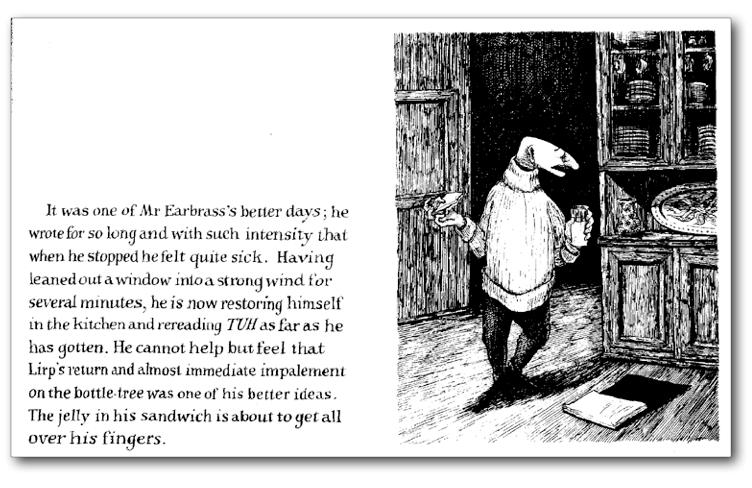
Excerpt From A Work-In-Progress
“I’d like to be very honest with you, yes? So let’s have a candid discussion.” And here you jump because the Engineer is now just behind your eyeballs, as if psycho-acoustically leaning forward to better share a secret. “There’s something strange about Formal Absences, and I wonder, perhaps, if you can’t hear it because you’re still so close to the work?” And then a long pause while he finds neutral language and rehearses its delivery. “The songs, well, they often seem at odds with the collection’s production–sometimes only slightly, but also in larger ways, yes?”
And you jump once more, but this time because the observation shakes you. As a producer back there in London, maybe the Engineer had been the real deal. Or perhaps he’s just approaching the tracks with fresh ears and 10 years’ distance. Nevertheless, the collection’s feel has always niggled at you: base level, it was what you intended, but not quite what you meant. Which, in retrospect, might have been the reason The Formal Absences of Precious Things had crash-landed in the stores and burned up in reviews. Heartbreaking and, yes, unlistenable.
“At odds? In what way? Specifically, I mean.” Not said defensively because for the moment the complex politics of the re-release have been put aside; it’s a kind of time-out–or something like one–where The Engineer is no longer channeling the dry caution of the company.
“Well, it’s like a double exposure in photography, yes? Two things at once–one on top of the other? Most of the time, the songs are saying this, while the production is implying that. And it can be quite disconcerting–I mean, well here you go, have a listen . . .”
You’d always anticipated there’d be time to prepare for that flip into the earlier version of yourself. But in the end, it turns out to be like the dentist, where the lip is jiggled as a distraction before the needle goes in: first the diversion of the Engineer’s concerns, and then the sudden jab of playback that is, despite the metallic taste in your mouth, the opposite of Novocain. You haven’t listened to Formal Absences in the last ten years, not even to prepare for remastering. There’s been no need because somewhere deep inside the songs have never stopped playing. Indefensible stuff, really–well, just look at them, Darling.
Punched into the corner monitors of the speaker array, the carefully constructed stereo image of “Post-Modern Pop Song” materializes. The phantom bassist, 45 degrees left of center, pumps out the minor-key reggae riff. And then, from an illusory stage right, the entrance of someone you no longer are and yet somehow remain:
When you went, you took the light;
now there’s only darkness inside of me
Though I crumble out of sight,
you would never know it to look at me . . . .
Beatrice: that dead-of-winter when she’s gone, equidistant from fall and spring; a place where the old colors have been forgotten rather than faded and the new ones are nowhere in sight; those words that permanently stain your heart with the gray-scale of that afternoon; the dirty snow, the dun-colored clouds and the early nights of too-short days that are also somehow endless. Only darkness is left inside . . . .
Grasping the sides of the swivel chair, thumbs digging into the seat cushion . . . .
Beatrice: months, maybe years, gone away from living; hiding yourself in the everyday, turned inward and inside-out, self-medicating and self-loathing; yearning to no avail, serving the self-imposed sentence by writing sentences; journals that might someday make sense of this–messages to a future self from a place that has no future; forever drowning and then writing yourself back to the surface. Crumbling out of sight . . . .
Face expressionless, eyes unseeing: night terrors, but you’re awake . . . .
Beatrice: an autumnal afternoon, a half-remembered eternity later, with steadier hands and transfixed by the day after a residency in darkness; your life once more thrown into relief next to a golden sun beam illuminating dust motes as you’re finally able to write what you’ve been unable to say to anyone. When you went, you took the light . . . .
Swept away in a current of time that’s not the one flowing around the Engineer . . . .
Beatrice: now suddenly unseen spring; behind studio walls conjuring up the undead and giving voice to the unspeakable; the pantomime propriety of taping confessions after long-passed judgments, all in the name of art-as-commerce; unarticulated loss now strictly metered and click-tracked, so that which changed everything forever could be expressed as a momentary, disposable pop song; the attempt to balance on the taut lines of craft above the abyss of your own creation. You would never know it to look at me . . . .
The instantly reconstituted past closing over your head; the sinking into it, the surface shimmer of the studio growing dimmer and more distant as you descend through a deepening twilight.
This is how she reenters your life.
On a sweltering day in front of Washington’s Union Station, pigeons protect their leader–The One Not Like Them Who Never Interacts. Avian legend says that if The One Not Like Them Who Never Interacts ever moves, it will signal the pigeon End Times . . .

Excerpt From A Work-In-Progress
Downstairs at the bar in Black Gang Chine, anticipating this meeting with Jack, you light a Gauloise and contemplate how best to explain yourself. Thus far Cult Artist, cliched or not, sounds pretty good–if said fast and with authority, not allowing questions to form, it captures andconveys the essence of what you’re still calling your career.
And yet when you are recognized, it’s most frequently through the writing you’ve done for others, and less–with that one massive exception, of course–for any of the music that you kept for yourself. So there’s a problem of accuracy in this self-labeling: your own songs are appreciated by a small base of fans, but too few for even a cottage patronage of your work. You’ve come to call this Fractal Economicsbecause the alpha’s always the omega–because no matter how small an endeavor is, it’s still all about the fucking numbers.
Black Gang Chine is beneath The Gosford, which in turn is below Frontera, and you’ve arrived a full 30 minutes in advance to compellingly re-edit yourself. The actual bar is slyly Kubrick: an antiseptic light from within the thing diffuses through the translucent counter–it’s like drinking on top of a medical light box that awaits the x-rays of your broken career. And although you’ve no desire to examine that damage, it’s impossible to ignore the florescent glow because the only other light in this subterranean room comes from a few scattered, alcoved candles . . . .
You look out over the glinting sea of lofted, disposable lighters, and then take care of business with the crowd-pleasing anthem about a spectral woman . . . .
No, goddamnit, begin again. The most important thing is you’ve written the best pop songs never heard by a mainstream audience. Best in this case meaning nuanced, uncompromised pieces that only meet the listener half way. You don’t write hits; you pen songs that sometimes are modestly successful for other artists. But, as “Not Really Green Eyes” clearly proves, if called upon, you can construct a monster. These days, however, you have little interest in chart wars and the business end of music: these days there are lines you just won’t cross, no matter how much money stands to be made. Said fast and withresolute authority, not allowing questions to form.
But once again, there’s that matter of accuracy. Because it’s much more than the refusal to cross certain lines: it’s also the fear around three in the morning that you only think you know how to write hit songs. That sitting down and consciously trying to conjure-up one might prove–to yourself and the world–that the one time had been a fluke. And the essence of your career . . . .
In the men’s room, puking in a urinal; haunted by the last thing she had said . . . .
Third try, then. Big, deep breath. You’re the guy who wrote “Not Really Green Eyes.” Yes, that one–the one on the radio; the one inescapable all that summer; the one that was stately and progressive and about the woman you were living with at the time. So obviously you’ve got The Touch, and, well, any label needs artists with that. Which makes the deal you’re discussing now that much more attractive–and also cost-effective because these days there’s just you. Back when the song had topped the charts, there’d been a band–though in truth, Dark Victory’s revolving membership had made it more of a concept than a group. But nevertheless, you’re solo now; like someone militantly single after a bad divorce. And to keep yourself from wincing here, you light another Gauloise.
The exposed-brick walls of Black Gang Chine are those of a 19th century cellar. In contrast, however, the furnishings of the club extend the tone of the luminous bar: you’re seated in the middle of an antique fever-dream of a tomorrow that never happened: where the Ripper’s Whitechapel is collided into Lang’s Metropolis–and this intrusion of each into the other, with no effort made to meld them, produces a temporal yin and yang; an entanglement, but with demarcations.
One more time, but with all the cards on the table–and therefore not for the meeting: you’ve no explanation why “Not Really Green Eyes” climbs to number one. As in not a single clue. As in no-fucking-idea-whatsoever . . . .
She’s just gotten sick, and your concern, while great, is shaped by television narratives: She’s the beloved guest star, so despite test results, it’s bound to be fine in the end. Because that’s always the way these things work out in all the medical dramas–some dodgy touch-and-go in the second act, followed by a cure. Said fast and with nervous authority, without pausing for questions to form.
But make no mistake, in spite of appearances, this is survival, not denial: unavoidably sometimes the informed and the clueless arrive at the same destination. Because yes, you fully comprehend the horrors yet to come, you’re already deep into sleepless nights, but during the day you do your best to cling to hope–it keeps you from drowning in all the bad news.
It’s been a season filled with grim diagnoses: Dark Victory is on life-support and your songwriting’s been seriously ill–and there the simple prescription is, of course, the bashing-out of better tunes. It’s time to work-up a new collection both you and the public can live with, but the constant worry over Jan and the group and what’s left of your professional future is a less-than-ideal place from which to storm the fortress of popular taste.
But then to your astonishment, you simply manage to succeed–you back into the formidable barriers and, shockingly, they tumble down. It’s like knocking over the most expensive vase on entering a high-end boutique, and then finding that the accident has made you the new owner of the shop. The initial impulse to flee, however, stubbornly remains. And so when people offer congratulations, you learn to give them a knowing smile–as if The Plan is working like a charm; as if everything is Right On Schedule. Signaled slyly and with authority, not allowing questions to form.
Except that there is no plan, and certainly no schedule: Elton John topples from number one, and you’ve no clue how you did it. As in What-the-hell-did-I-just-do? As in no-fucking-idea-whatsoever.
“Not Really Green Eyes” is a story about the various stations of love; a miniature epic moving from doubt to heartfelt certainty. Maybe the self-exposure of the lyric grounds the studio majesty of the cut, the significance of what’s being said equal to the wide-stage, stereo grandeur. Maybe the music buyers like confessional transformations that play-out in six pop-song minutes. Maybe radio programmers think they’ve found “Born To Run,“ finally unburdened by cars. Maybe deep inside you’re certain of what the disease will do to her. Perhaps the song is actually your oblique and ungentle goodnight. Afterwards, when all you have left is time, you’ll endlessly ponder these
things . . . .
One more run at it–there’s just enough time–once again for yourself, and not Jack . . . .
As her health unravels and the band falls apart, the blurring shock begins to fade, and you find yourself finally able to focus on caregiving and careful writing. Both demand putting the needs of others before your own, and you develop a meticulous servility about medications and theoretical hits.
“Not Really Green Eyes” is intended to be just another cautious, machine-tooled lyric, but something unexpected occurs: spontaneity and inspiration connect. The moment is entirely without drama; there’s no enlightened sense of occasion–you’re merely giving yourself a brief holiday by working in the old way again. She’s across the room, napping on the couch; something she’s never done in the past. It’s late October, and the thinning light is as golden and brittle as the leaves. You watch her sleep in the silent apartment, and, to better keep the time, meter each line to the beat of a heart that you’ve always hidden away.
You’ll realize later it’s the last quiet moment before you find a career and lose something precious. Before Death, like a pack rat, leaves something shiny in tragic exchange for her.
The arcing chart-climb of “Not Really Green Eyes” blazes across her final days, descending, then, into the utter desolation that’s left in their wake. The mayfly existence of a hit pop song bookends last-stage illness and burial, which is planned by relatives after private discussions that pointedly don’t include you . . . .
Downstairs at the bar in Black Gang Chine, anticipating this meeting with Jack, you light a Gauloise and contemplate how best to explain yourself.
Excerpt From A Work-In-Progress
At the last moment “Not Really Green Eyes” snags you a three-record solo deal; a lifeboat miraculously within jumping distance as the scuttled Dark Victory sinks. And the only thing you need to do to square this deal with Triumph Music is ensure that lightning strikes again (and then maybe one more time). But you’re not worried; this isn’t the hard part–well, at least not yet. No, the terrible price is having to sing that song each night on tour. Every encore you look out over a glinting sea of lofted, disposable lighters, and then take care of business with the crowd-pleasing anthem about a spectral woman. Afterwards, as you leave the stage, you always wave and shout Good Night, creating the impression that both these things are intended for the crowd. Said fast and with devastated authority, defying questions to form.
In this way, the Dark Pack Rat again returns, this time for your new, uncompromising start, leaving in its place something thin and fraying–but potentially lucrative and thus shiny. It feels like Faust 101, or something very close to it–a back-ended bargain you should have refused had you not misplaced your balls.
Your deal produces two acclaimed disasters, and the final release repeats the pattern–cursory support and tepid sales precede the cut-out racks. But this time there are no glowing reviews to cushion your collision with the bargain bin. You learn pop success is a ménage à trois: commercialism, critical acceptance and fan love in tangled intimacy–in essence, the circumstances guarantee at least one of them will wind-up hurt. So when your contract with Triumph isn’t renewed, there’s no real surprise. In the middle of open and empty sea, your lifeboat finally sinks.
You try hard to hard not to think about that third release; it was a classic Hail-Mary pass. Triumph had driven the wedge of nonexistent sales between your taste and tenacity: it was time, they said, to get Deeply Serious, because the music world was changing. And further, they said, you had to stop acting like it was 1973. And, after consideration, that was exactly what you did–by resolutely entering the studio and recording Mercenary Love.
Long before “Not Really Green Eyes” had made its unexpected way up the charts, music critic Chuck Mancuso had done his enfant terriblething, ordaining that in a crowded field, you were the only new songwriter to watch (as many years later, with a drug-proof consistency, he’d also praise your first solo album). But his Uncutreview of Mercenary Love was just a single, terse paragraph: “Like his namesake city in World War II, singer-songwriter Anthony Dresden is now a bombed-out shell of his former talent. Which explains why ‘painful’ is the only way to describe the wanna-be pop songs on his new release. Each track is like driving a blunt nail through my hand with the hammer of his vanished intelligence.” Oh yeah? Well, fuck you too, Chuckie M–both you and that hammer / intelligence thing. Because if you stop and really think about it, what the hell does that even mean?
What follows is three years in the wilderness: ad agency jingles, session work and the odd, increasingly infrequent gig. And although no one in the business ever calls you, the checks for “Not Really Green Eyes” still appear.
But what should have happened is something you’ve forbidden yourself to dwell on: after the Triumph crash-and-burn, you’d worked hard to trust yourself again, and then recorded a small-label album that was a genuine return to form. But the critics never saw it, much less any of the public, because, goddamnit, it was never released. The four-person indie had suddenly folded–before the promos were even unboxed. And later that day one of the newly unemployed with taste and what turned out to be foresight, had walked with all those unopened cartons containing your new release. For years afterwards, you’d see your “lost album” selling to collectors for crazy sums. So much money, in fact, you stared at your own copy longer than you should have–until, thank god, self-disgust had flooded-out the temptation. The hollow-shell essence of your bombed-out career.
Ultimately, of course, this can’t go on, and you have to do what’s always filled you with dread: acquiesce to that long-deferred sit-down between yourself and industry reality. So you turn off the TV, ignore all calls and ask pointed questions about where you stand. And hours later, after taking stock and realizing there’s no way out–or rather, in this case, no way back in–you finally pick up that jangling phone and find Jack Magnus on the other end.
A sudden afternoon deluge, gone as quickly as it arrived, leaving the yard glistening and Monet-like in the sun.

Here’s how we play: Sometimes I need to talk to myself in the form of essays about technique–a long time ago I discovered that all my best thinking involves a degree of explaining. Thus this post is primarily for myself, but as always, you’re welcome to eavesdrop.
Over the past year or so, I’ve occasionally posted excerpts from a work in seemingly endless progress. They were shards deemed sufficiently finalized for placement in an online window because–on a number of levels–they really were like still-warm pies. And I have to admit I’ve been both surprised and flattered by the variety of visitors they’ve attracted.
Recently, however, I’ve been thinking about limitations of such excerpts. Their successful selection for optimal stand-alone scrutiny ensures the complete absence of original context. In effect, a highlight from a much larger work has been wrested and severed and retrofitted to vaguely operate as a short story.
For instance, here’s a paragraph carefully chosen because it contains a miniature backstory arc:
Big, Deep Breath
Third try, then. Big, deep breath. You’re the guy who wrote “Not Really Green Eyes.” Yes, that one–the one on the radio; the one inescapable all that summer; the one that was stately and progressive and about the woman you were living with at the time. So obviously you’ve got The Touch, and, well, any label needs artists with that. Which makes the deal you’re discussing now that much more attractive–and also cost-effective because these days there’s only you. Back when you had topped the charts, there had been a band–though, in truth, Dark Victory’s revolving members had made it more of a conceptual group. But nevertheless, you’re solo now; militantly single after a bad marriage. And to keep yourself from wincing here, you light another Gauloise.
Here also, is the attendant vocal test, because yes, I’m still writing this book that way; in every instance a final-draft passage is the one that works best when read aloud–by design, Best Vocalization even trumps technically better “page writing.”
[restore audio link]
“Big, Deep Breath” is not necessarily the best piece of writing I could have chosen, but it is, however, perfectly suited as a bite-sized bit of meaning–its tiny “story” neatly ends with an equally minuscule “closure” (or, rather, something that out of context can be made to function that way).
But here’s the thing: “Big, Deep Breath,” while not the book’s stellar passage, is a far better piece of writing than its excerpt-context suggests. Things are happening in the paragraph that can only properly resonate within the larger work. Sometimes it’s not so much the struck orchestral triangle as it is the interplay of the surrounding acoustics: the book quite literally can be seen as the missing concert hall.
It’s no wonder, then, that these days I’ve been wondering if a better way might be possible–one that doesn’t involve a work becoming its own weird set of Cliff Notes. And then this morning it suddenly struck me that what I wanted was a kind of film trailer.
Coming Attractions have always fascinated me because the best ones rise above the obligation to simply intrigue an audience. A world-class trailer captures the film’s quintessence without necessarily telling its story–or, and this is significant, even adhering to its timeline. In fact, a great trailer frequently conveys a movie’s emotional resonance by significantly rethinking its structure. While the logic of this is obvious (no one–not filmmaker, studio, theater or audience–is best-served by a two-minute Classics Illustrated version), the odd Is / Not-Is of a great trailer is magical in the same way a 20-minute John Coltrane deconstruction of “My Favorite Things” nevertheless remains emotionally true to the vastly different original song.
Since this morning, I’ve been wondering if a collection of excerpts from the book could be cut together and made to function in the manner of an artful film trailer–as a meditation on its essential themes, but not necessarily a mirror.
What I envision is something luxuriously long, at least by the standard of conventional excerpts–perhaps as many as 10,000 words–something with no obligation to match the event-arc of the book.
Given that part of the novel is concerned with the remixing of songs in a recording studio, let me try to put this another way: imagine an instance where the dance mixes of a song collection–which are usually after-the-fact exercises–function instead as its pre-release singes. Imagine getting to know these artful mutations before you meet the real thing.
I’m not claiming that this is breakthrough thinking, but I also can’t recall any instances of book-excerpt-as-film-trailer. So if this has been done, it’s happened only rarely, and–flashing amber light here–possibly for good reason . . .
Despite the lack of other examples, I’m still inclined to see what I can do with this concept. If a book proposal conveys what happens in a story, then film-trailer excerpts could demonstrate how it feels. It goes back to the aforementioned Is / Not-Is of all the best Coming Attractions–just as fiction is a true lie about the world, a further fictionalizing of the relationship of its excerpts might hew truer to the larger, imminent work.
Okay, so Google has its knickers in a bunch about Bing–I get it: time for desperate Me-Too moves. Which, of course, means saying goodbye to the comforting minimalism of Google’s input page. And given my taste for austere interface design, you can imagine that I’m a bit grumbly about this.
However, I’m also the sort of Can-Do Guy who sees opportunities in almost everything, and since a picture was needed–wait for it–there was no question that it had to be Tilda. Further, the fact that the Google elements had been redesigned to be knocked-out of the background meant my old friend Black needed to be called in–to keep things appropriately quiet. It’s just the way I stylistically roll . . .
Thus, a video screen-grab and and little Pixelmator later, this is my new and (yes, vastly) improved search page. Opportunity. More accurately, given my Tilda-smitten circumstances, thrilling opportunity.

Gardening on a perceptually 100-degree day: Washington, DC is built on a swamp, and so the drill is simple–buy only tropical flowers, find a hat and generally suck it up.
A favorite pastime of Washingtonians is looking askance at tourists reduced to tears by the humidity. (To paraphrase Peter O’Toole in Lawrence Of Arabia, the trick is not minding that the air is so thick, it almost hurts.)

Sent from my iPhone
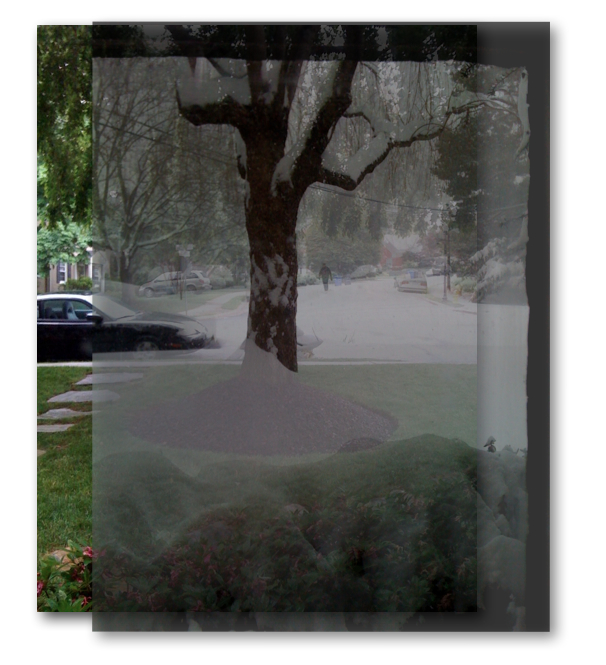
Two overlaid shots from one window equals a February haunting . . .
In one of those increasingly prevalent and startling online juxtapositions, YouTube has clips of Marianne Faithfull singing identical arrangements of “As Tears Go By” that are separated by 44 years of living–a period in??which she lost her voice and first-blush beauty and, in the process, found herself. What emerges is a portrait of an artist who has grown into her material, filling it out with hard-earned maturity.
She owns the 2009 version of “As Tear Go By” in ways that are both unimaginable and impossible in 1965. In 2009, she plucks the song from within herself, singing from a vantage of understanding; the missed notes of her wabi-sabi voice enriching the song instead of diminishing it.
In 1965, the mission had clearly been negotiation of the next phrase, while in 2009, she’s thinking ahead to the succeeding conveyance of emotion. Solemn wistfulness has been replaced by a complex, world-weary bemusement: Four decades have significantly shifted the song’s center of gravity–where it was once about experiencing, it’s now about recollection.
This is underscored by revisiting a 45-year-old pop hit using its original arrangement. By choosing the same musical frame for an unavoidably much-changed performance, Faithfull is signaling that this is not marginal gloss on or a reinterpretation of her earlier version. Rather, it’s a deconstruction of personal and pop history–an act of artistic defiance. Using the same arrangement purposely inserts an unequal sign between the two performances–the absence of further continuity forces the listener to focus instead on the differences.
In her own “Bored By Dreams” (from A Secret Life), Faithfull observed, “After a certain age / Every artist works with injury.” And that’s what I think her 2009 Jagger/Richards simulacrum is doing–tapping into the lessons learned from missteps and demonstrating their uses . . .

Sent from my iPad
I was just passing through the study, carrying my iPhone and minding my own business, when–wham— the Phillips Collection suddenly breaks out . . .

Sent from my iPad
I happen to be downtown tonight for dinner and snapped this picture across the street from the Capitol.
See that light above the dome? It’s only there when Congress is in session, which in this case means the Senate.
Over there in the darkness Republicans are doing everything in their power to send HCR back to the House. But I also have to believe that over there in the darkness Democrats are too smart, too focused and too committed to be stopped in getting HCR done.
That light up there means that The People’s Business is being conducted. And standing here tonight, that light looks a lot like hope.

Sent from my iPhone
It doesn’t get much more FanBoi than this–some brief notes on a lunch-hour project that paid big aesthetic dividends:
I’m finally getting around to ripping last year’s Beatles remasters into iTunes, and I’ve been deferring Let It Be because, well, you know–the whole Spector Wall-of-Sound thing. My problem is that I have absolutely no issues with the mixes of the purely live tracks–I actually like them. But when the orchestras and choirs smother “The Long and Winding Road,” “I Me Mine,” “Let It Be” and “Across the Universe,” I’m a massively unhappy music lover.
Now, I know what you’re going to say–because I thought about it, too: Why not simply rip McCarney’s remixed and resequenced Let It Be . . . Naked? Well, (a) as already noted, I like most of the mixes on the original collection; (b) Sir Paul and company wound-up over-producing the touted under-production–it’s stripped back, yeah, but also given a sonic Photoshopping to within an inch of its art, and, closely related, (c) the sound stage on the Let It Be . . . Naked is weirdly flat–there’s almost no depth to those remixes.
Thus, I was still wondering what to do with Let It Be when??something occurred to me: The Beatles’ Past Masters had also been remastered–and disc two contained fabulous versions of “Get Back,” “Across the Universe” and “Let It Be.” (And, as a side-benefit, these are George Martin productions.) Do you see where I’m going with this?
Further, on the second disc of The Beatles Anthology 3, there are un-Spectorized live-in-studio versions of “The Long and Winding Road” and “I Me Mine,” that were also produced by Martin. Versions, it should be noted, that were blessed at the time by all three surviving Beatles. [See update at the end of this post.]
So let’s recap: By swapping-in the aforementioned alternate Let It Be songs, I manage to retain the quality of the 2009 remasters in all but two cases; I eliminate those vastly annoying wall-of-sound moments; and I give almost half of the collection back to George Martin, who had originally produced it upstream of Phil Spector. And additionally, I’m able to keep the original sequencing of the collection (which is far superior to Sir Paul’s retread).
During lunch today, I ripped into iTunes the songs needed for my reconsidered version and matched the levels of the swapped material to those of the remaining songs from the remastered Let It Be.
In addition, I trimmed the opening of the inserted “Across the Universe” by 20.7 seconds to lose the birds-in-flight sound effects. Wings, however, still do briefly flutter at the end of the cut, and during another lunch hour, I’ll fire-up GarageBand and create an earlier fade to also eliminate this effect. On the other hand, I let remain George’s studio-chatter intro to the new “I Me Mine” because it matched the other snippets of conversation which punctuate the collection.)
A couple seconds of silence was also trimmed from the end “For You Blue” to more quickly begin the new “Get Back.”
And there you have it–with mindboggling Fan Hubris, I’ve managed to “fix” a recording that’s been bugging me for 40 years. For me, Let It Be is now completely wince-free, but, of course, your own mileage may vary . . .
Instructions for Making Your Own Reconsidered Let It Be
Take one 2009 remaster of Let It Be and swap-in the following material:
1. “Two of Us”
2. “Dig a Pony”
3. “Across the Universe”
(Past Masters, 2009 remaster, George Martin, producer)
4. “Don’t Let Me Down”
(Past Masters, 2009 remaster, George Martin, producer)
5. “I Me Mine”
(The Beatles Anthology 3, 1996 remaster, George Martin, producer)
6. “Dig It”
7. “Let It Be”
(Past Masters, 2009 remaster, George Martin, producer)
8. “Maggie Mae”
9. “I’ve Got a Feeling”
10. “One After the 909”
11. “The Long and Winding Road”
(The Beatles Anthology 3, 1996 remaster, George Martin, producer)
12. “For You Blue”
13. “Get Back”
(Past Masters, 2009 remaster, George Martin, producer)
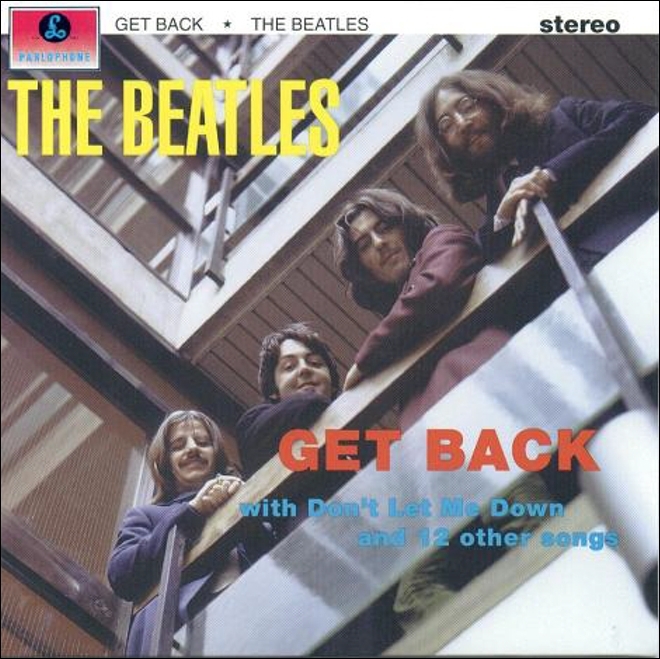
[Updates: Upon further consideration, I’ve opted to use the basic track of “Across The Universe” found on the second disc of The Beatles Anthology 2. It takes the song down a semi-tone to its original speed, dispenses with the non-Beatle backing vocals and completely loses the sound effects.
In addition, “Don’t Let Me Down,” from the stereo Past Masters compilation, was added as the fourth song. This was done in deference to an earlier, nearly released version of the album–as evidenced by its inclusion on the cover art.]
You were terrified by Village of the Damned; you were chilled by Children of the Damned–but this summer nothing can prepare you for
House Cats of the Damned
They’ve been asleep for what seems like centuries, but now mankind’s use of electric can openers has awakened them . . .

Sam-Splicing ™ is made possible by Sam Elliott’s immaculate, almost miraculous consistency across roles in disparate films. The unintended benefit of this is the possibility of immeasurably improving any motion picture that features Elliott by simply adding an appropriately looped version of his Big Lebowski introduction.
Take, for example, The Golden Compass, which received mixed reviews upon its release. Now imagine this film Sam-Spliced ™. The film would open with outtake footage of Elliott’s airship floating through the night sky as we listen to Elliott’s voiceover:
***
“A way out in the multiverse there was an ermine, ermine I want to tell you about, ermine by the name of Pantalaimon. At least, that was the handle his lovin’ parents gave him, but he never had much use for it himself. This Pantalaimon, he called himself the Daemon. Now, Daemon, that’s a name no one would self-apply where I come from. But then, there was a lot about the Daemon that didn’t make a whole lot of sense to me. And a lot about where he lived, like-wise. But then again, maybe that’s why I found the place s’durned innarestin’.
“They call Torre degli Angeli the Tower of Angels. I didn’t find it to be that exactly, but I’ll allow as some nice folks lived there once. ‘Course, I can’t say I seen Oxford, and I never been to Bolvangar, and I ain’t never seen no queen in her damn undies as the fella says. But I’ll tell you what, after seeing Torre degli Angeli and thisahere story I’m about to unfold–wal, I guess I seen somethin’ ever’ bit as stupefyin’ as ya’d see in any a those other places, and in English too, so I can die with a smile on my face without feelin’ like the good Lord gypped me.”
***
Now admit it–don’t you immediately feel more predisposed to The Golden Compass than ever before? Yeah, me too. And this, ladies and gentlemen, is the potential power of Sam-Splicing ™. I rest my case.

The unswerving consistency of Sam Elliott:The Big Lebowsk and The Golden Compass
 CultureHack